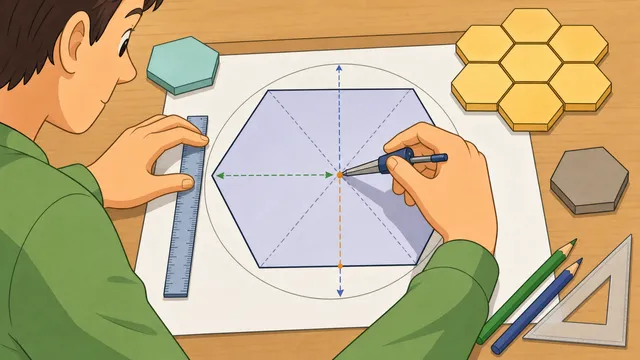
Calculate regular polygon area, perimeter, angles, diagonals, apothem, and circumradius from side length, perimeter, area, apothem, or radius.
Last updated
Regular polygon solver
Choose the number of sides, then solve the regular polygon from side length, perimeter, area, apothem, or circumradius. The result includes area, perimeter, angles, radii, diagonals, and circle-fit checks.
Quick examples
Load a familiar shape, then change the side count or known measurement.
Known measurement
How this worksheet helps
Use this when one equal edge length is known. Every supported measurement is converted back to side length first, then the full regular-polygon geometry is rebuilt from that common base.
Result
Area = 64.95
Solved from side length 5. Solved side length is 5. The same value drives area, perimeter, radii, angles, and diagonals because the polygon is regular.
Side length
5
Perimeter
30
Apothem
4.33
Circumradius
5
Interior angle
120°
Exterior angle
60°
Total diagonals
9
Centre triangles
6
Formula and fit checks
Use these rows to verify the angle arithmetic, diagonal count, centre-triangle split, and circle comparisons.
Check
Amount
Why it matters
One centre triangle
10.83
The polygon splits into 6 congruent isosceles triangles from the centre.
Diagonals from one vertex
3
Useful for checking the total diagonal count without double-counting.
Angle sum
720
The total of all interior angles in degrees.
Outer circle fill
82.7
Percent of the circumscribed circle occupied by the polygon.
Inscribed circle area
58.9
Largest circle that fits inside the polygon.
Circumscribed circle area
78.54
Smallest circle that contains every vertex.
How to read the result
These formulas assume a regular polygon: every side has the same length and every angle is equal. If your shape is irregular, one side, radius, apothem, or area is not enough to recover the full geometry.
Regular polygon calculator for area, perimeter, angles, apothem, radius, and diagonals
Use this regular polygon calculator to solve any equal-sided, equal-angled polygon from number of sides plus side length, perimeter, area, apothem, or circumradius. It then reports area, perimeter, interior angle, exterior angle, apothem, circumradius, diagonal count, centre-triangle area, and circle-fit comparisons.
What a regular polygon calculator solves
A regular polygon has all sides equal and all angles equal. That symmetry means one compatible measurement is enough to rebuild the entire shape once the number of sides is known. The calculator converts side length, perimeter, area, apothem, or circumradius back to side length first, then uses that solved side to calculate every other result.
This is broader than a basic polygon area calculator that only accepts side length. Many real geometry questions start with a perimeter, a known area, a centre-to-side apothem, or a radius from the centre to a vertex. Supporting those entry points makes the page useful for worksheets, drafting checks, tiling layouts, and regular n-gon comparisons.
P = ns
Perimeter equals number of sides n times side length s.
A = ns^2 / (4 tan(pi/n))
Area from side length for a regular n-sided polygon.
a = s / (2 tan(pi/n)), R = s / (2 sin(pi/n))
Apothem a and circumradius R from side length.
Solving from side length, perimeter, area, apothem, or radius
When side length is known, the formulas apply directly. When perimeter is known, divide perimeter by the number of sides. When area is known, rearrange the area formula to recover side length. When apothem or circumradius is known, use the regular-polygon right triangle formed by the centre, a vertex, and the midpoint of a side.
The result always shows the solved side length so you can audit the conversion. This is important because area, apothem, and radius inputs can look similar in a word problem but lead to different values if the wrong measurement is chosen.
Worked example: regular hexagon with side length 5
For a regular hexagon with 6 sides and side length 5, the perimeter is 6 × 5 = 30. The area is 6 × 5^2 / (4 × tan(pi/6)), which is about 64.95 square units. The interior angle is 120 degrees, the exterior angle is 60 degrees, and the diagonal count is 6(6 - 3)/2 = 9.
The same result can be reached from a perimeter of 30 or a circumradius of 5 because a regular hexagon has a special relationship: its side length equals its circumradius. Other regular polygons do not all share that shortcut, which is why the calculator keeps the solve mode explicit.
6 sides
Side length 5
Perimeter 30
Area about 64.95 square units
9 diagonals
Interior angles, exterior angles, and angle sum
The interior angle of a regular polygon is ((n - 2) × 180) / n. The exterior angle is 360 / n, which is also the central angle between adjacent vertices. These angle relationships are often the fastest way to check whether a regular polygon result is plausible.
The total interior angle sum is (n - 2) × 180 degrees. A triangle sums to 180 degrees, a quadrilateral to 360 degrees, and each additional side adds another 180 degrees to the total.
Interior angle = ((n - 2) × 180) / n
Each interior angle in degrees for a regular polygon.
Exterior angle = 360 / n
The turn angle at each vertex and the central angle between adjacent vertices.
Diagonals and centre triangles
The total number of diagonals in any n-sided polygon is n(n - 3)/2. The calculator also shows diagonals from one vertex, which is n - 3. That makes it easier to understand why the total formula divides by 2: counting from every vertex would otherwise count each diagonal twice.
A regular polygon also splits into n congruent triangles by drawing lines from the centre to each vertex. The calculator reports the area of one centre triangle because it is a useful way to check the total area and understand the apothem-based area formula.
Apothem, inradius, circumradius, and circle-fit checks
The apothem is the distance from the centre to a side. It is also the inradius of the largest circle that fits inside the regular polygon. The circumradius is the distance from the centre to a vertex, which defines the smallest circle that can contain the polygon.
Circle-fit comparisons become more useful as the number of sides increases. A regular polygon with many sides begins to approximate a circle, so the percentage of the outer circle occupied by the polygon helps explain why high-sided n-gons look nearly round.
Regular polygon versus irregular polygon
This calculator is intentionally for regular polygons only. If a polygon has unequal sides or unequal angles, a single side length, radius, apothem, or area is not enough to determine all other dimensions. Irregular polygons need additional side lengths, coordinates, triangulation, or another geometry method.
The distinction matters for practical work. A regular pentagon, hexagon, or octagon can be solved from one known measurement. An irregular five-, six-, or eight-sided shape cannot be recovered from one number without extra assumptions.
What this calculator does not cover
The calculator assumes ideal Euclidean plane geometry. It does not model rounded corners, chamfers, material thickness, manufacturing tolerances, map projections, three-dimensional prisms, or irregular polygon coordinates.
Use the result as a geometry worksheet and planning aid. For construction, fabrication, or engineering drawings, confirm the unit convention, tolerance, and whether the given measurement is side length, apothem, circumradius, area, or perimeter.
Frequently asked questions
How do you calculate the area of a regular polygon?
If side length s and number of sides n are known, use A = ns^2 / (4 tan(pi/n)). You can also use A = perimeter × apothem / 2 when perimeter and apothem are known.
How do you calculate the perimeter of a regular polygon?
Multiply the number of sides by the side length. For example, a regular hexagon with side length 5 has perimeter 6 × 5 = 30.
Can I solve a regular polygon from area?
Yes. The calculator rearranges the regular polygon area formula to solve side length first, then calculates perimeter, apothem, radius, angles, and diagonals from that side length.
What is the apothem of a regular polygon?
The apothem is the distance from the centre of the polygon to the midpoint of a side. It is also the inradius of the largest circle that fits inside the regular polygon.
What is the circumradius of a regular polygon?
The circumradius is the distance from the centre to a vertex. It is the radius of the circle that passes through every vertex of the regular polygon.
How many diagonals does a polygon have?
An n-sided polygon has n(n - 3)/2 diagonals. A hexagon has 6(6 - 3)/2 = 9 diagonals.
What is the interior angle formula for a regular polygon?
Each interior angle is ((n - 2) × 180) / n degrees. A regular pentagon has 108-degree interior angles, and a regular hexagon has 120-degree interior angles.
What is the exterior angle formula?
Each exterior angle is 360 / n degrees. Exterior angles are useful because they show the turn angle around the polygon.
What happens as the number of sides increases?
The regular polygon approaches a circle. The side-to-side edges become shorter relative to the radius, and the area gets closer to the area of the circumscribed circle.
Can this calculator solve irregular polygons?
No. These formulas require all sides and all angles to be equal. Irregular polygons need more measurements, coordinates, or triangulation.
How can I check a regular polygon calculator result manually?
Check the solved side length first, then verify perimeter = ns, exterior angle = 360/n, and diagonal count = n(n - 3)/2. Those quick checks catch most input-mode or formula mistakes.