Use the endpoint calculator to find the missing endpoint from one endpoint and the midpoint, with formula steps, 2D/3D support, a 2D coordinate preview.
Last updated
Find the other endpoint from a midpoint Use this endpoint calculator when you know one endpoint A and the midpoint M. It solves the missing endpoint B, checks that M is still halfway between A and B, and shows the distance on each half of the segment.
Quick examples
Dimensions
Known endpoint A
Midpoint M
Result
Missing endpoint B
(7, 7)
2D endpoint solved by mirroring the known endpoint across the midpoint.
Segment length
7.2111
A to M
3.6056
M to B
3.6056
Segment type
diagonal
Delta x
6
Delta y
4
Midpoint verification
Recomputing the midpoint of A and B gives (4, 5), matching the midpoint you entered.
A to M is 3.6056 units and M to B is 3.6056 units, so the two halves are equal.
Line context
The segment slope from A to B is 0.6667 and the direction angle is 33.6901 degrees.
Coordinate preview
A is mirrored across midpoint M to place B on the same line, the same distance beyond the midpoint.
Find the missing endpoint from midpoint and one endpoint
The endpoint calculator finds the missing endpoint of a line segment when you know one endpoint and the midpoint. It reverses the midpoint formula to solve for the unknown point, then verifies the answer by recomputing the midpoint and comparing the two half-segment distances. Use it for coordinate geometry homework, 2D or 3D endpoint formula checks, and problems where a midpoint must stay exactly halfway between two endpoints.
How the endpoint formula works
If M is the midpoint and A is the known endpoint, then the unknown endpoint B = 2M - A. This works for each coordinate independently: Bx = 2*Mx - Ax, By = 2*My - Ay.
The formula is derived by rearranging the midpoint equation M = (A+B)/2 to solve for B. This find the missing endpoint from midpoint and one endpoint formula explanation shows how the entered values flow into the main result and the supporting figures the calculator returns.
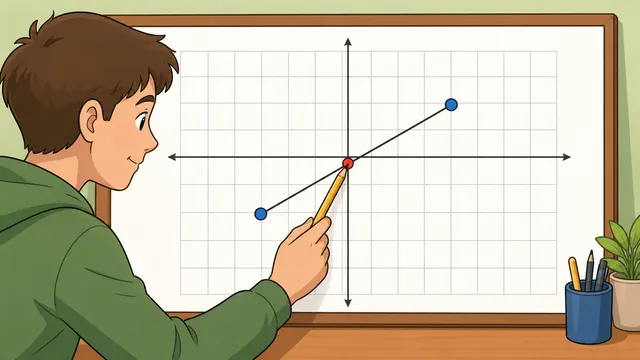
Another way to think about it is reflection. The midpoint is the center of the segment, so the missing endpoint must be the same coordinate change beyond the midpoint that the known endpoint is before it. If A is 3 units left of M, then B is 3 units right of M. If A is 2 units below M, then B is 2 units above M.
B = 2M - A
The missing endpoint equals twice the midpoint minus the known endpoint.
Bx = 2Mx - Ax, By = 2My - Ay
Apply the endpoint formula separately to each 2D coordinate.
Bz = 2Mz - Az
In 3D, apply the same midpoint reversal to the z-coordinate.
What this endpoint calculator shows
The calculator returns the missing endpoint B, the total segment length from A to B, the distance from A to M, and the distance from M to B. Those distance checks are important because a correct midpoint splits the segment into two equal lengths.
The result also identifies whether the segment is horizontal, vertical, diagonal, a single point, or spatial in 3D. For 2D inputs it adds slope and direction angle when those values are defined, which helps distinguish a coordinate typo from a correct mirrored endpoint.
Step-by-step formula substitution is included so you can see exactly how each coordinate was solved. This is useful for negative coordinates because subtracting a negative endpoint is a common source of mistakes.
For 2D endpoint problems, the result also includes a coordinate preview that places A, M, and B on a simple grid. The sketch is not a substitute for the formula, but it makes the reflection across the midpoint easier to inspect before copying the answer.
Worked example: A(1,3) and M(4,5)
Suppose one endpoint is A(1, 3) and the midpoint is M(4, 5). Apply the endpoint formula to x first: Bx = 2*4 - 1 = 7. Then apply it to y: By = 2*5 - 3 = 7. The missing endpoint is B(7, 7).
You can verify the answer by averaging the coordinates of A and B. The x midpoint is (1 + 7) / 2 = 4, and the y midpoint is (3 + 7) / 2 = 5. That gives M(4, 5), matching the midpoint you started with.
The distance from A to M equals the distance from M to B because M is halfway along the segment. If those two distances do not match after solving by hand, the endpoint calculation or one of the copied coordinates is wrong.
Negative coordinates, decimals, and 3D endpoints
The endpoint formula works with any real-number coordinates, including negative values and decimals. For A(5, -3) and M(0, 0), the missing endpoint is B(-5, 3), because the midpoint is exactly halfway between the mirrored coordinates.
Decimals follow the same rule. If A(1.5, 2.5) and M(4.5, 6.5), then Bx = 2*4.5 - 1.5 = 7.5 and By = 2*6.5 - 2.5 = 10.5.
In 3D, solve x, y, and z separately. For A(1, 2, 3) and M(4, 5, 6), the missing endpoint is B(7, 8, 9). The midpoint check then averages all three coordinate pairs back to (4, 5, 6).
Endpoint formula versus midpoint and distance formulas
Use the endpoint calculator when the midpoint and one endpoint are known and the other endpoint is missing. Use the midpoint calculator when both endpoints are known and the halfway coordinate is missing. Use the distance calculator when the main answer is the straight-line length between two points.
All three formulas describe the same line segment from different directions. The midpoint formula averages coordinates, the endpoint formula rearranges that average to solve for a missing coordinate, and the distance formula measures the resulting segment length.
This distinction matters for search intent and for solving the right worksheet problem. A prompt asking for the other endpoint from a midpoint needs B = 2M - A, not the ordinary midpoint formula by itself.
The most common mistake is subtracting in the wrong direction. The missing endpoint is not M - A. It is 2M - A, because the midpoint coordinate must be doubled before the known endpoint is removed.
Another frequent error is dropping the sign on a negative coordinate. If the known endpoint is negative, the endpoint formula subtracts that negative value. For example, By = 2*7 - (-4) becomes 14 + 4, not 14 - 4.
A third mistake is using the formula for only one coordinate. The endpoint must be solved coordinate by coordinate, so a 2D problem needs both x and y, while a 3D problem needs x, y, and z.
Limitations
This calculator assumes the midpoint divides the segment in a 1:1 ratio. For other division ratios, use the section formula.
The calculator assumes ordinary Cartesian coordinates, not latitude and longitude on Earth's surface. It does not calculate road distance, route distance, geographic midpoint, or a great-circle endpoint.
The result depends on the coordinates entered. If the point labels are swapped or the midpoint belongs to a different segment, the formula will still return a mathematical reflection, but it will not represent the intended geometry problem.
Frequently asked questions
If one endpoint is (1,2) and the midpoint is (4,5), what is the other endpoint?
(7, 8). Bx = 2(4) - 1 = 7. By = 2(5) - 2 = 8. The page uses this rule as a quick reference, but the surrounding assumptions and units still matter when you interpret the result.
Can I verify my answer?
Yes - compute the midpoint of the known endpoint and your answer. It should equal the given midpoint.
What is the endpoint formula?
The endpoint formula is B = 2M - A, where A is the known endpoint, M is the midpoint, and B is the missing endpoint. In 2D that means Bx = 2Mx - Ax and By = 2My - Ay.
How do you find the other endpoint with a midpoint and one endpoint?
Double each midpoint coordinate, then subtract the matching coordinate of the known endpoint. Do this separately for x and y, and also for z if the problem is in 3D.
Does the endpoint formula work with negative coordinates?
Yes. Keep the signs exactly as written. If the known endpoint coordinate is negative, subtracting it becomes addition, which is why writing the substitution step helps prevent sign errors.
Can this endpoint calculator solve 3D coordinates?
Yes. Switch to 3D mode and enter x, y, and z for the known endpoint and midpoint. The calculator applies the same formula to all three coordinates.
Is finding an endpoint the same as finding a midpoint?
No. Finding a midpoint averages two known endpoints. Finding a missing endpoint reverses that average when one endpoint and the midpoint are already known.
Why does the calculator show A to M and M to B distances?
Those distances verify the midpoint. A true midpoint is the same distance from both endpoints, so A to M and M to B should match.
What if the known endpoint and midpoint are the same?
Then the missing endpoint is the same coordinate too. The segment length is zero, so the midpoint, known endpoint, and missing endpoint all collapse to one point.
Can I use this for latitude and longitude?
Not for geographic accuracy. This page assumes flat Cartesian coordinates. Latitude and longitude need map or great-circle methods, especially over longer distances.
What if the midpoint divides the segment in a ratio other than half?
Then this endpoint formula is not the right model. The midpoint formula only applies to a 1:1 split. For another ratio, use a section formula or ratio-of-segment method.