Use a paper quantity converter to switch between sheets, quires, reams, bundles, bales, cartons.
Last updated
Convert paper quantities and build an orderable pack plan This converter handles the common office-paper convention, short reams for specialty stock, and printer's perfect reams, then turns the result into cartons, reams, quires, and loose sheets with optional overage for real print jobs.
Quick examples
Enter the base quantity, pick the paper-count standard your supplier uses, and add overage if the job needs spoilage or setup allowance. The converter keeps the raw sheet count visible while also showing the procurement-friendly package breakdown.
Paper quantity result
12,750 sheets
Under the office / copy paper standard, the recommended order becomes 13,388 sheets:
2 cartons + 6 reams + 15 quires + 13 sheets.
Base sheets
12,750
Orderable sheets
13,388
Overage sheets
638
Rounded cartons
3
Interpretation
Office / copy paper uses 500 sheets per ream. A base need of 12,750 sheets becomes 13,388 sheets after 5% overage, which maps to 2 cartons + 6 reams + 15 quires + 13 sheets.
Best for modern office stock, school supply rooms, and standard copier paper cartons.
Recommended order plan
2 cartons + 6 reams + 15 quires + 13 sheets. If you round up to whole reams only, you would buy 27 reams and carry
112 extra sheets.
Carton-rounding check
Buying only sealed cartons means 3 cartons,
which leaves 1,612 sheets above the target requirement.
Pallet planning check
Using 40 cartons per pallet, the rounded sealed-carton order equals 0.075 pallets.
That is 0 full pallets plus 3 loose cartons.
Exact unit conversions
Unit
Exact conversion
With overage
Ordering note
Sheets
12,750
13,388
Single loose sheets, useful for exact print-run counts and leftovers.
Quires (25 sheets)
510
535.52
Modern 25-sheet quire used for partial ream planning.
Bulk packaging conversions
Unit
Exact conversion
With overage
Ordering note
Reams (500 sheets)
25.5
26.776
Modern office-paper benchmark for one wrapped pack.
Bundles (1,000 sheets)
12.75
13.388
Two reams together, useful for mid-size ordering and stock pulls.
Bales (5,000 sheets)
2.55
2.6776
Large shipping quantity shown here as ten reams under the selected standard.
Cartons (5,000 sheets)
2.55
2.6776
Sealed shipping carton based on ten reams under the selected count standard.
Packaging assumption This converter uses the office / copy paper convention: 1 quire = 25 sheets, 1 ream = 500 sheets, and 1 carton or bale = 5,000 sheets.
Paper quantity converter for sheets, quires, reams, bundles, bales, and cartons
A paper quantity converter is most useful when it answers the ordering question as well as the unit question. This page works as a sheets-to-reams converter, a ream-to-carton converter, and a print-order pack planner so you can move from a print-run count to the packaging language used by stationers, office buyers, and print suppliers, while also checking which count standard the supplier is actually using.
What a paper quantity converter should help you answer
Most people do not search for a paper quantity converter because they enjoy old stationery vocabulary. They search because a printer, school office, or purchasing form is asking for reams or cartons while the actual job is being counted in sheets. The useful question is not just how many sheets equal a ream. It is how the sheet count maps to practical packages you can actually order, issue from stock, or carry to press.
That is why this converter keeps the total sheet count visible and also breaks the result into cartons, reams, quires, and loose sheets. For procurement and print-room planning, that operational breakdown is usually more useful than a lone decimal conversion such as 25.5 reams. If you searched for a sheets-to-reams converter, that pack breakdown is the extra step that turns a basic unit answer into an order you can actually place.
The pallet field adds one more buying check that static paper quantity charts usually cannot provide. Supplier pallet counts vary, so the calculator lets you enter the cartons-per-pallet assumption from the quote or warehouse rule and then translates the rounded sealed-carton order into full pallets plus loose cartons.
It also adds something many thin competitors skip: a count-standard choice. That matters because a modern office-paper ream usually means 500 sheets, but a short ream or a printer's perfect ream may use a different count. If you do not confirm the standard first, a mathematically correct conversion can still turn into a bad order.
Modern office counts versus historical and printer counts
A quire has traditionally meant 24 or sometimes 25 sheets depending on the paper context. A ream has also varied historically, with older references using counts such as 480, 500, or 516 sheets. In ordinary office-paper purchasing today, the practical working assumption is usually a 25-sheet quire, a 500-sheet ream, and a 10-ream carton, which is the default many office buyers expect.
That difference matters because historical publishing language and modern copy-paper packaging do not always line up neatly. If you are handling routine office stock, school paper, or commodity print paper, a 500-sheet ream is the right operational default. If you are working from archival, specialist, or printer-facing references, the supplier may instead quote short reams or perfect reams.
This page therefore lets you switch standards instead of treating every paper unit as universal. That makes the tool more useful for both office supply ordering and specialist print planning, because the conversion sheet updates to the chosen convention rather than burying the assumption in a footnote.
total sheets = entered quantity × sheets per selected unit
Normalises the chosen unit back to sheets so every other quantity can be compared from one base count.
equivalent units = total sheets ÷ sheets per target unit
Converts the same sheet total into quires, reams, cartons, bundles, or bales under the selected count standard.
Adds spoilage or setup allowance so a print order can be packed as an orderable quantity instead of a bare theoretical count.
Worked example: turning a print run into cartons and reams
Suppose a print job needs 12,750 sheets under the common office-paper standard. The raw conversion tells you that this equals 25.5 reams, but that is not how the order will usually be handled on the floor. A more practical reading is 2 cartons, 5 reams, and 10 quires. That tells you how much stock can stay sealed, how many reams need to be broken open, and what remains outside full packages.
Now add a 5% overage allowance for spoilage and setup. The requirement becomes 13,388 sheets after rounding up to a whole orderable count. The operational pack plan changes to 2 cartons, 6 reams, 15 quires, and 13 sheets. That is the sort of procurement answer buyers and print-room staff actually need.
The same logic helps on smaller jobs as well. If you need 250 sheets under the modern office convention, the result is not just 0.5 reams. It is also 10 quires. That is often the more useful interpretation for stationery rooms and copy centres because it maps directly to issue quantities rather than forcing staff to interpret decimal reams.
Use sheets when the job count comes from pages, impressions, or press-run estimates.
Use reams when you are buying or replenishing standard office paper.
Use cartons when the order must stay in sealed boxes for storage, freight, or procurement controls.
Use overage when the job needs waste allowance, setup sheets, or a safety margin above the exact count.
When short reams and perfect reams matter
A common search pattern around paper quantity is really a disguised standards question: how many sheets in a ream, how many sheets in a quire, or why one source says 500 while another says 480 or 516. The answer is that the count depends on the paper convention being used, not just on the word itself.
Short reams can appear with specialty papers, while a printer's perfect ream includes extra sheets to reflect handling or spoilage allowances in classic printing contexts. If you buy or quote against those standards using the wrong baseline, you can be off by dozens or hundreds of sheets before the order even reaches press.
That is why this converter keeps the standard selector visible. It is not decorative metadata. It changes the actual pack sizes, the carton total, and the recommended procurement breakdown.
Further reading
Merriam-Webster — ream definition — Dictionary reference showing that historical ream counts varied rather than being permanently fixed at 500 sheets.
PrintWiki — ream — Printing reference explaining why modern 500-sheet reams coexist with older 480-sheet conventions.
Pallet and case assumptions should come from the supplier
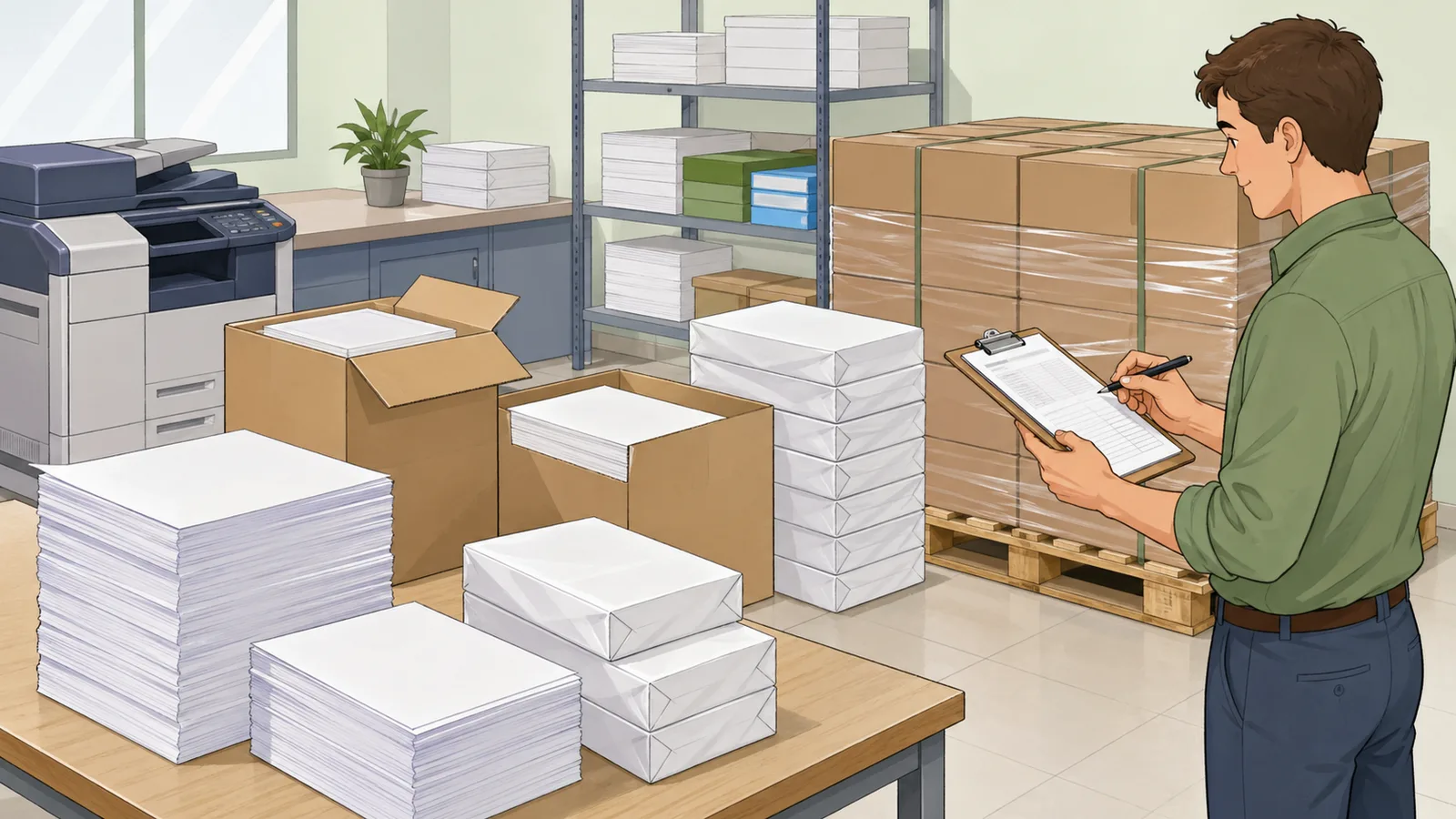
Paper quantity search results often mention pallets, cases, cartons, bundles, and bales as though every supplier uses the same packaging ladder. That is not safe for a real purchase order. A carton is commonly treated as ten 500-sheet reams for office copy paper, but pallet counts can vary by supplier, region, stock size, handling limits, and whether the listing is using cases, boxes, or wrapped cartons.
For that reason, this calculator does not hard-code one universal pallet. It first converts the job into sheets, then reams and sealed cartons, and then lets you apply the cartons-per-pallet number that appears on the supplier quote. That makes it useful for school supply rooms, office buyers, print shops, and warehouse teams that need to know whether an order is a few loose cartons or a palletised delivery.
If the supplier gives only a pallet sheet count, divide that sheet count by the sheet count per carton under the selected standard and enter the result as cartons per pallet. For example, under the office-paper standard, a 200,000-sheet pallet equals 40 cartons of 5,000 sheets each. A different supplier pack size should be entered directly rather than forced into that example.
This tool converts quantity only. It does not tell you the paper weight, thickness, GSM, basis weight, brightness, or shipping mass of the order. Two cartons can contain the same number of sheets but very different physical weight depending on the stock specification.
It also does not decide whether every supplier defines a bale, carton, case, or pallet exactly the same way for every specialist product. This page uses a simple operational assumption of ten reams per carton or bale within the chosen count standard, because that is how many mainstream office-paper listings present a case quantity. If your supplier uses a different packaging convention, follow the supplier specification rather than the default assumption here.
If you need freight, print-weight, or stock-thickness planning, pair this page with a paper weight or paper thickness reference. Quantity planning is only one piece of the purchasing workflow.
In modern office-paper buying, a ream usually means 500 sheets. Historically, the word has also been used for counts such as 480 or 516 sheets. This converter lets you switch between office, short, and perfect ream conventions so the count matches the context instead of assuming one fixed definition.
What is a quire of paper?
A quire is a traditional paper-count unit, commonly treated as 25 sheets in modern office-paper references or 24 sheets in short-ream contexts. It is useful when a sheet count does not divide neatly into full reams and you want a more practical breakdown than a decimal fraction of a ream.
Why does this converter offer office, short, and perfect ream standards?
Because suppliers and print references do not always use the same sheet count. Office paper usually works with 500-sheet reams, some specialty papers use short reams of 480 sheets, and classic printing references may use perfect reams of 516 sheets. The standard changes the pack math, so it should be chosen explicitly.
How do I add overage for a print run?
Enter the exact base quantity, then add the overage percentage you want for spoilage, setup, or a safety reserve. The calculator converts the raw count into a rounded-up orderable quantity and then breaks that requirement into cartons, reams, quires, and loose sheets.
Why is the overage result rounded up?
Because you cannot order a fraction of a physical sheet in a practical procurement workflow. The calculator rounds the required sheet total up so the order plan reflects what can actually be packed, pulled, or purchased.
Why does this converter treat a bale and a carton as the same count?
Because the page is aimed at practical office and print-order planning, where a sealed case is commonly handled as ten reams under the selected count standard. Some specialist suppliers may use different packaging language, so always check the supplier specification when buying nonstandard stock.
How many cartons are on a pallet of copy paper?
There is no single universal pallet count. A common office-paper example is 40 cartons of 10 reams each, or 200,000 sheets under the 500-sheet ream standard, but suppliers and regions can use other carton or box counts. Enter the cartons-per-pallet value from the quote or warehouse rule so the calculator shows full pallets and loose cartons for your order.
Can this converter tell me how much the paper order will weigh?
No. Quantity and weight are different questions. The converter can tell you how many sheets, reams, or cartons a job needs, but the shipping weight depends on paper size, GSM or basis weight, thickness, and packaging.
Is this page for office supplies only?
No. It works for office-copy stock, school supply rooms, and print-room planning, but it is also useful when you need to translate between historical paper units and modern pack sizes. The standard selector is what makes it flexible across those contexts.