Use this unit vector calculator to normalize a 2D or 3D vector, verify its magnitude, and work through the full vector normalization steps.
Last updated
Unit vector calculator Use this unit vector calculator to normalize a 2D or 3D vector, verify its original magnitude, and see the direction-preserving vector normalization steps. It is useful when you are finding the unit vector, checking unit vector notation, or turning raw components into a direction vector of length 1.
Dimension
Normalized vector
(0.6, 0.8)
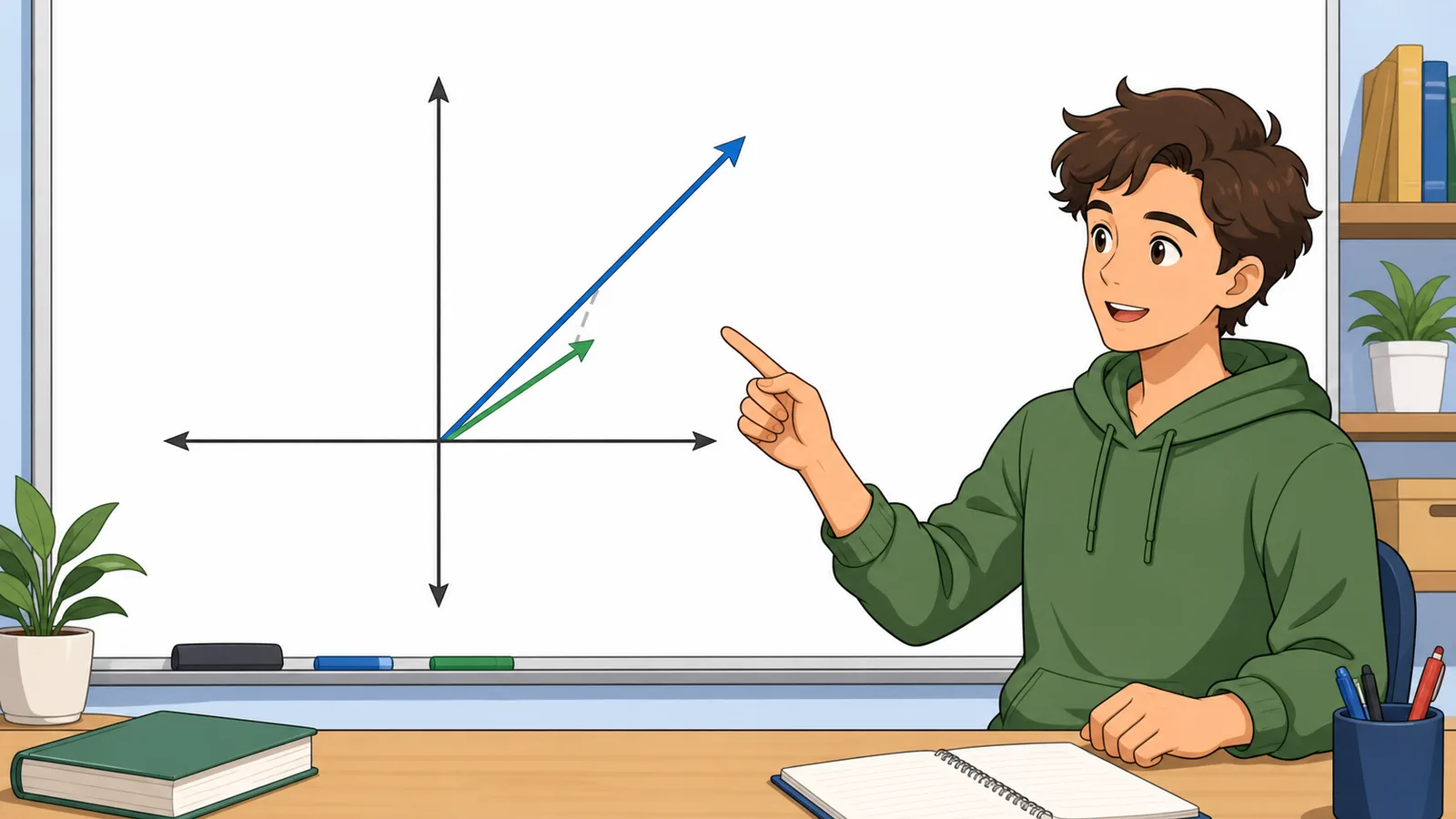
The unit vector for (3, 4) has magnitude 1 and points in the same direction as the original vector.
X component
0.6
Y component
0.8
Original magnitude
5
i/j/k notation
0.6i + 0.8j
Direction preserved
Same direction, new scale
A unit vector changes only length, not direction, so the component ratios still describe the same line of action.
Magnitude check
1
The verification magnitude confirms the normalized result is a true unit vector of length 1.
Interpretation
2D direction vector
Use the normalized components when you need direction only, such as i/j/k basis-vector notation, projection work, or vector decomposition.
What vector normalization means
A normalized vector keeps the same direction as the original vector but rescales its magnitude to exactly 1. That is why a unit vector calculator divides every component by the original vector magnitude instead of changing the direction ratios between components.
When normalization is undefined
The zero vector has magnitude 0, so there is no valid way to divide by the magnitude. A zero vector has no direction to preserve, which is why a unit vector solver must reject it.
Step-by-step normalization
Sum of squares
3² + 4²
= 9 + 16 = 25
Magnitude |v|
√(25)
= 5
Unit vector
3 / 5, 4 / 5
= (0.6, 0.8)
Decimals versus exact values This calculator shows decimal components for speed and readability. If your course or proof expects exact radicals or fractions, use the same normalization steps here and keep the square-root form symbolically.
Unit vector calculator: normalize a vector to length 1
A unit vector calculator normalizes a vector by dividing each component by the vector magnitude. Use it when finding the unit vector, checking vector normalization, or converting 2D and 3D components into a direction vector with magnitude exactly 1.
What this unit vector calculator solves
This page takes a vector in component form and returns the corresponding unit vector, meaning the normalized vector that points in the same direction but has length 1. It supports both 2D and 3D input, shows the original magnitude, and breaks the normalization into explicit calculation steps.
That makes it useful for searches such as unit vector calculator, find unit vector calculator, normalize vector calculator, and finding the unit vector, where the practical need is to preserve direction while standardizing magnitude.
The unit vector formula
To normalize a vector v, divide the full vector by its magnitude |v|. In component form, that means each component is divided by the same magnitude so the direction stays unchanged.
For a 2D vector (x, y), the magnitude is √(x² + y²). For a 3D vector (x, y, z), the magnitude is √(x² + y² + z²). Once the magnitude is known, divide each component by that value to get the unit vector.
û = v / |v|
Normalize a vector by dividing it by its magnitude.
|v| = √(x² + y² + z²)
Magnitude formula for 3D vectors; omit z for 2D vectors.
Why normalization preserves direction
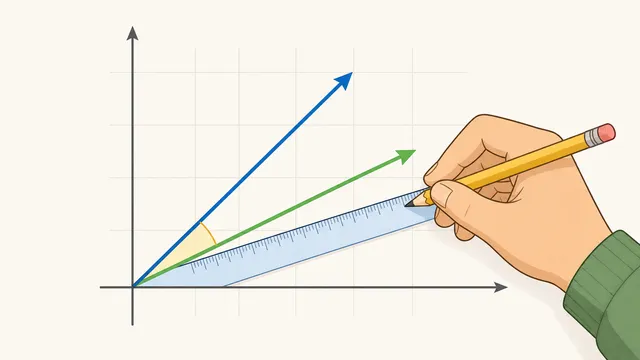
A unit vector is not a different direction. It is the same direction scaled to a new length. Because every component is divided by the same magnitude, the ratios between components stay the same, so the arrow still points the same way in the plane or space.
This is why vector normalization is useful in geometry, physics, graphics, and machine learning. It lets you separate direction from size and work with direction alone.
Worked examples
For vector (3, 4), the magnitude is 5, so the unit vector is (3/5, 4/5) = (0.6, 0.8). This is the classic 3-4-5 example used to show the normalization process clearly.
For vector (1, 2, 2), the magnitude is 3, so the unit vector is (1/3, 2/3, 2/3). In each case, the normalized result points in the same direction but has magnitude exactly 1.
The zero vector has magnitude 0, so the normalization formula would require division by zero. More importantly, the zero vector has no direction to preserve, so there is no meaningful unit vector associated with it.
That is why any correct unit vector solver must reject (0, 0) and (0, 0, 0) instead of trying to return a default answer.
Decimals versus exact unit vector notation
This calculator presents decimal results because they are quick to read and practical for verification. In many algebra, geometry, and physics settings, however, exact forms such as (3/5, 4/5) or expressions with radicals may be preferred.
If your class or proof requires exact notation, use the same normalization steps shown here and keep the radical form until the end. The calculator is still useful because it verifies the workflow and the direction.
The calculator also shows i/j/k basis notation for the normalized result, so a vector such as (0.6, 0.8) can be read as 0.6i + 0.8j and a 3D vector can be written with i, j, and k components. That helps when you are moving between tuple notation, unit vector notation, vector normalization homework, and physics-style component form.
Tuple notation and i/j/k notation
Tuple notation, such as (0.333333, 0.666667, 0.666667), lists the normalized vector components in order. Basis-vector notation writes the same information as 0.333333i + 0.666667j + 0.666667k, where i, j, and k point along the x, y, and z axes.
Both forms describe the same unit vector. Use tuple notation when entering values into software or checking a coordinate result, and use i/j/k notation when a textbook, physics problem, or vector decomposition question asks for the answer in standard basis form.
Unit vectors, direction vectors, and tangent vectors
A unit vector is any vector of magnitude 1. A direction vector is any vector that points along a line or path, whether or not its magnitude is 1. A unit tangent vector is a calculus-specific normalized tangent vector taken from a curve, so it is related but not the same task as normalizing a free vector from components.
That distinction matters because queries like unit tangent vector calculator have a different input model. This page is for direct vector normalization from components, not derivatives of parametric curves.
Frequently asked questions
How do you find a unit vector?
Find the magnitude of the vector, then divide every component by that magnitude. The result has the same direction but a magnitude of exactly 1.
What is the unit vector formula?
The formula is û = v / |v|, where v is the original vector and |v| is its magnitude.
Why can't the zero vector be normalized?
Because its magnitude is 0, so normalization would require division by zero. The zero vector also has no direction to preserve.
How do you verify a unit vector has magnitude 1?
Square each component, add the squares, and take the square root. A valid unit vector always gives a magnitude of exactly 1, subject to rounding in decimal form.
What is the difference between a vector and a unit vector?
A general vector can have any magnitude. A unit vector is a special case with magnitude 1, usually used to represent direction only.
Can this calculator normalize 2D and 3D vectors?
Yes. It supports both 2D and 3D component input and applies the same normalization idea to either dimension.
Should I use exact fractions or decimals for a unit vector?
Use decimals for quick interpretation and checking. Use exact fractions or radicals when a class, proof, or symbolic solution requires exact notation.
How do I write a unit vector in i, j, k notation?
Normalize the vector first, then attach each normalized component to its matching basis direction. For example, the 2D unit vector (0.6, 0.8) can be written as 0.6i + 0.8j, while a 3D result uses i, j, and k.
What does vector normalization mean?
Vector normalization means rescaling a vector so its magnitude becomes 1 while keeping its direction unchanged.
How is a unit vector related to direction?
A unit vector isolates direction by stripping away the original size of the vector. That is why normalized vectors are often used as direction vectors.
What is the difference between a unit vector and a unit tangent vector?
A unit vector is any magnitude-1 vector. A unit tangent vector is a specific unit vector derived from the tangent direction of a curve in calculus.