Calculate cabinet door size from opening dimensions, overlay style, reveal, centre gap, and door count, then estimate total door area, hinge count.
Last updated
Cabinet door sizing Estimate door width, door height, total door count, and material area from a cabinet opening, door count, reveal assumptions, and overlay style.
Quick examples
Overlay style
Door style
Sizing assumptions Door style changes the look, not the maths. Inset doors stay inside the opening, while overlay styles add the chosen projection before the reveal is removed.
Recommended cut size
315 mm x 752 mm
8 doors across 4 openings using full overlay shaker sizing.
Per-door width
315 mm
Per-door height
752 mm
Door count total
8
Estimated hinges
16
Per-opening door area
0.47 m²
Total door area
1.9 m²
How to use this result
Order 8 shaker full overlay doors at 315 mm x 752 mm, then verify each opening, hinge overlay, and supplier rounding rule before cutting or purchasing.
2 hinges per door is a planning estimate for a 752 mm tall door. Confirm hinge count, cup bore, and mounting plate with the hardware supplier.
Use the per-door dimensions to cut or order the doors, then multiply by the total count for the full project. If you are building shaker or raised-panel doors, keep the cut size as the outer blank size and let the rail-and-stile joinery or panel inset define the final appearance.
Cabinet door sizing, overlay planning, and order quantities
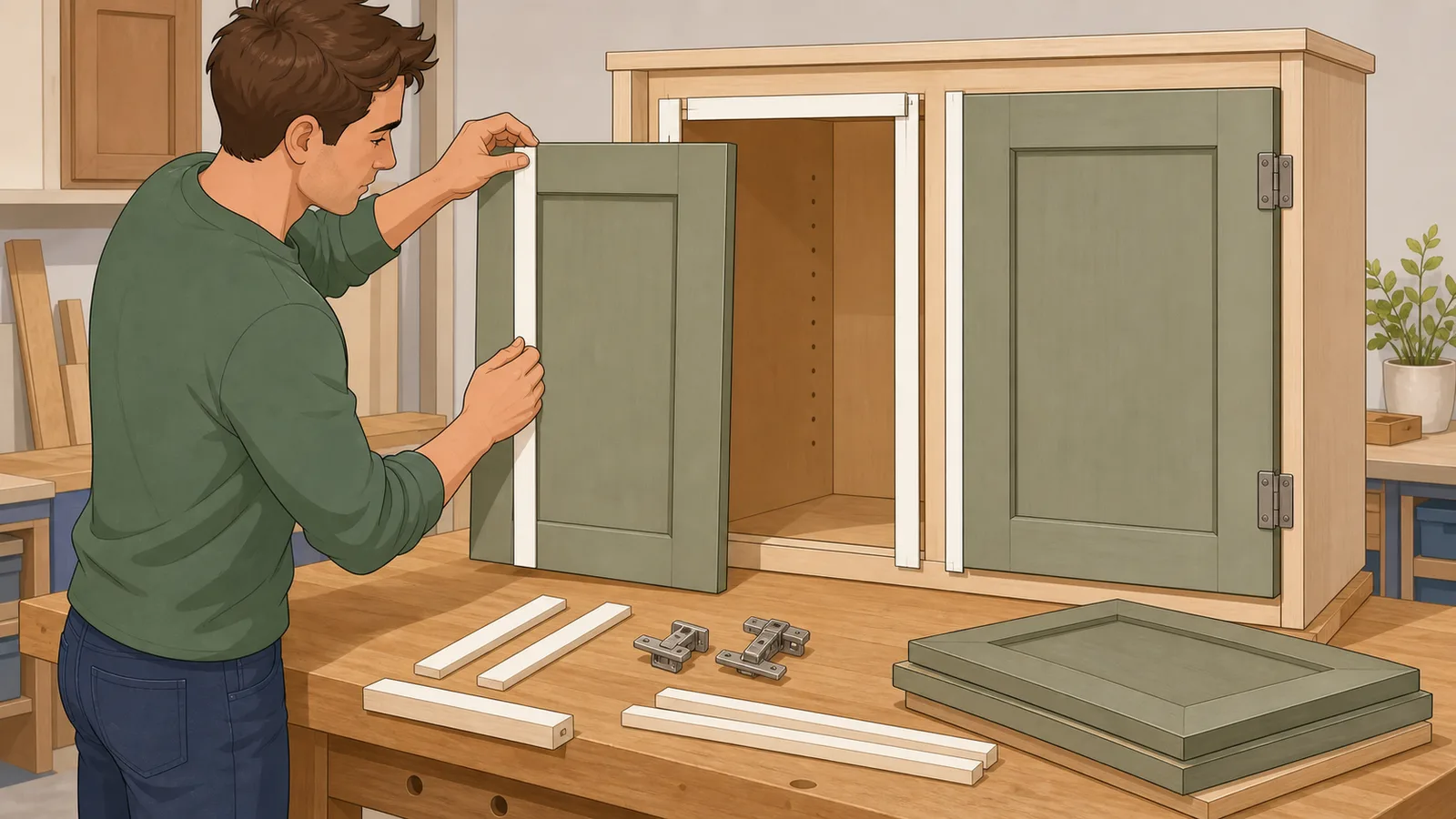
A cabinet door calculator helps you work out the cut size or order size for cabinet doors from the opening dimensions and the way the doors are meant to sit on the cabinet. It estimates door width, height, total door count, and total door area so you can compare inset, half-overlay, and full-overlay layouts before you build or order the doors.
What this cabinet door calculator is solving
Cabinet door sizing looks simple until reveals, overlay, centre gaps, and door count all start interacting. A calculator speeds up that layout work by taking the opening width and height, then adjusting the final door size based on whether the doors sit inside the opening or overlay the face of the cabinet.
That makes a cabinet door size calculator useful for new kitchens, utility rooms, built-ins, and replacement doors. It helps you test whether a two-door opening needs more overlay, a tighter centre gap, or a different style before you order blanks or send sizes to a door supplier.
How door width and height are derived
Inset doors sit within the opening, so the opening dimensions are reduced by the edge reveal and centre gap. Overlay doors add the chosen overlay projection first and then subtract the desired reveal so the door covers the face frame or cabinet side by the right amount.
Single-door width = (Adjusted opening width - Centre gap total) / Doors per opening
The calculator first adjusts the opening for inset or overlay assumptions, then divides the width across the number of doors on that opening.
Door height = Adjusted opening height
Height is based on the opening plus or minus the chosen reveal and overlay logic for the selected door style.
Overlay style, reveal, and practical fit
The most common sizing problems come from mixing overlay assumptions. A full-overlay layout usually needs a larger projection than a half-overlay layout, and an inset door needs a tighter tolerance because the door sits within the opening rather than over it. The calculator helps compare those scenarios quickly before you cut material or send a purchase order.
Use the total door count and area as planning outputs rather than finish-shop instructions. If you are building shaker, slab, or raised-panel doors, you still need to allow for the joinery method, hinge clearance, edge profiling, and the exact hardware system being used.
Worked example: a 600 mm opening with two full-overlay doors
Suppose a cabinet opening is 600 mm wide and 720 mm high, with two doors, a 3 mm edge reveal, a 2 mm centre gap, and a 19 mm full-overlay projection. The adjusted width becomes 632 mm and the adjusted height becomes 752 mm.
After subtracting the 2 mm centre gap and dividing the opening across two doors, each door comes out at 315 mm wide and 752 mm high. Four identical openings would therefore require 8 doors in total, which is exactly the kind of order-planning cross-check this calculator is meant to provide.
Hinges, tall doors, and order checks
Door size is only part of a cabinet-door order. A useful cabinet door calculator should also flag a rough hinge count because a short base-cabinet door and a tall pantry door do not usually use the same hardware quantity. The calculator estimates hinges from the finished door height, then multiplies by the total number of doors so you can price hardware at the same time as blanks or finished fronts.
Treat the hinge count as a planning allowance. European concealed hinges, face-frame hinges, inset hinges, soft-close hardware, and heavy raised-panel doors can all change the final count and boring pattern. Before ordering, match the overlay measurement, cup bore, mounting plate, and supplier tolerance to the exact hinge system.
What this estimate does not cover
This cabinet door sizing tool does not replace a final site measure. It does not account for out-of-square cabinets, hinge boring positions, warped openings, face-frame irregularities, or the detailed tolerances required by a specific hinge system. It also assumes consistent reveal and gap values across the job.
Treat the result as a planning and ordering estimate, then confirm every opening on site before cutting doors or submitting a final order.
Frequently asked questions
How do I measure for replacement cabinet doors?
Measure the cabinet opening width and height carefully, then decide whether the doors are inset, half-overlay, or full-overlay. The final door size depends on the overlay and reveal assumptions, not just the raw opening size.
What is the difference between inset and overlay cabinet doors?
Inset doors fit inside the opening and usually leave a small reveal around the edge. Overlay doors sit over the cabinet face or side, so the finished door is larger than the opening and the overlap amount matters.
Why does the centre gap matter on double cabinet doors?
Because the centre gap reduces the width available to each door. If the gap is too large, the doors become narrower; if it is too small, they may bind or look cramped once hinges and seasonal movement are considered.
How many hinges do cabinet doors need?
Short base-cabinet doors often use two hinges, while tall pantry or utility doors may need three, four, or more. This calculator includes a planning hinge count from the door height, but the final answer should follow the hinge manufacturer's load, height, and door-thickness guidance.
Can I order doors directly from this calculator result?
Use the result as a strong planning estimate, but always confirm the final dimensions against your site measure, hinge system, and supplier tolerances before placing the order.