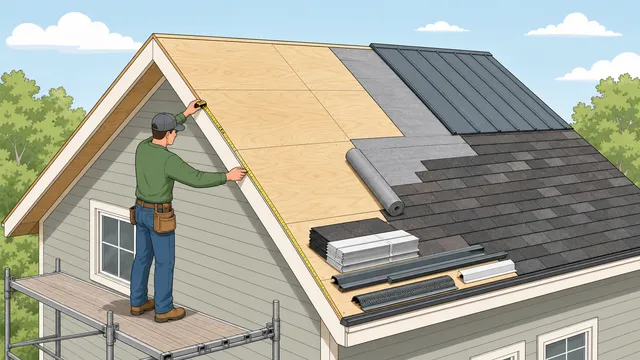
Calculate common rafter length from roof span, pitch, overhang, ridge-board thickness, and planned stock length, with slope factor, cut angles, rise.
Last updated
Common rafter planning Estimate common rafter length from roof span, pitch, ridge thickness, and eave overhang, then compare the cut length with your planned stock before framing.
Quick rafter examples
Result
3,469 mm
Estimated common rafter length including the sloped overhang, based on a roof span of 6,000 mm, a pitch of 150:1000, and a ridge deduction of 19 mm per side.
Planned stock length fits Your planned 4,800 mm board leaves about 1,331 mm before final trimming, plumb cuts, and layout marks.
Seat-cut length
3,014 mm
Adjusted run to ridge
2,981 mm
Rise to ridge
447 mm
Horizontal run
3,431 mm
Roof angle
8.53°
Overhang extension
455 mm
Pitch ratio
150:1000
Slope factor
1.01
Plumb cut angle
81.47°
Seat cut angle
8.53°
What changed the cut length?
The ridge thickness reduces the run to the ridge by half the board thickness, while the overhang is projected along the roof slope. The slope factor of 1.01 means each horizontal mm becomes 1.01 sloped mm along the rafter.
How to use this result
Use the common rafter length to choose board stock and mark rough cuts, then confirm birdsmouth depth, bearing, connector requirements, rafter size, and local code limits before cutting timber.
A rafter length calculator helps you turn roof span, roof pitch, ridge-board thickness, and eave overhang into a practical common-rafter estimate before you cut timber. It works out the rafter length, seat-cut length, roof angle, slope factor, rise to ridge, and planned stock fit so you can compare roof-framing options and rough board lengths more confidently.
What a rafter calculator is solving
A common rafter follows the diagonal line from the top plate to the ridge. If you know the roof span and the pitch, the roof geometry becomes a right-triangle problem: half the span gives the horizontal run toward the ridge, the pitch gives the rise over that run, and the rafter length follows from the hypotenuse.
That makes a rafter length calculator useful for sheds, garages, porches, and simple gable roofs. It helps you compare whether the roof pitch, overhang, ridge-board allowance, and planned stock length make sense before you move on to birdsmouth detail, rafter size, spacing, connector layout, or engineered framing requirements.
Core rafter formulas
The calculator first turns full roof span into half-span run, then uses the pitch ratio to calculate rise. The rafter to the seat cut comes from the basic roof triangle, and the overhang is added as an extension along the same roof slope rather than as a horizontal-only guess.
Half span = Roof span / 2
For a symmetrical gable roof, one common rafter runs from the wall line to the ridge over half the full roof span.
Adjusted run = Half span - (ridge thickness / 2)
When a ridge board is entered, the calculator deducts half of that thickness from each common rafter run instead of measuring all the way to the ridge centerline.
Rise to ridge = Half span x (Pitch rise / Pitch run)
The pitch ratio converts horizontal run into vertical rise for the chosen roof slope.
Rafter length = sqrt(run² + rise²)
The common-rafter length comes from the Pythagorean relationship between roof run and roof rise.
The slope factor converts horizontal distance, such as eave overhang, into sloped rafter length.
Using the result when framing a roof
The most useful outputs are usually the seat-cut length, the total rafter length including overhang, the roof angle, and the stock-length comparison. Together they tell you how much board length you need, how steep the roof is, and how much of the length sits outside the plate line at the eaves.
For example, a modest pitch may produce only a small difference between seat-cut length and total rafter length, while a steep roof with a generous overhang can add much more material than the plan view suggests. That is why it helps to check the overhang extension and stock allowance as their own numbers before you buy the timber.
Ridge board thickness and the actual rafter run
Many quick roof rafter calculators measure the run to the centerline of the roof. That is fine for a rough geometry sketch, but a common rafter bears against the side of a ridge board or ridge beam. If you are using a ridge board, deducting half its actual thickness gives a tighter line-length estimate for the top plumb cut.
The live calculator keeps that field optional. Leave ridge thickness at zero for a centerline estimate, or enter the actual ridge thickness when you are comparing a framing layout. This still does not design the ridge member or check whether a ridge board, ridge beam, rafter ties, or another engineered detail is required.
Stock length, slope factor, and cut planning
A common rafter length is not very useful if it stops at one number. The calculator also compares the result with your planned stock length and reports whether the board is long enough before plumb cuts, birdsmouth layout, tail trimming, and field adjustment. That makes it easier to choose between common stock lengths before ordering.
The slope factor is the shortcut behind the calculator. A 6/12 pitch has a slope factor of about 1.118, so each horizontal inch of run becomes about 1.118 inches of sloped rafter length. The same factor explains why a 12 inch horizontal overhang adds more than 12 inches of actual rafter tail on a pitched roof.
Use planned stock length as a procurement check, not a final cut list.
Allow extra length for layout marks, saw kerfs, imperfect framing, and final tail cuts.
If the required common rafter length exceeds ordinary lumber lengths, check engineered lumber, trusses, or a project-specific framing design rather than assuming a splice is acceptable.
Common rafter inputs that people mix up
Roof span is the full wall-to-wall distance across the gable end. Rafter run is one side of that span after any ridge deduction. Overhang is normally measured horizontally from the outside wall line, not along the sloped rafter tail. Roof pitch is rise over run, not a degree angle.
Those distinctions matter because small input mistakes can move the ridge height, tail length, and stock recommendation. If you already know the rafter run from drawings, you can still use the calculator by entering twice that run as the roof span and leaving ridge thickness at zero.
Worked example: 6,000 mm span with 150:1000 pitch and 450 mm overhang
A 6,000 mm roof span gives a half-span run of 3,000 mm. If the ridge board is 38 mm thick, the adjusted run to the ridge-side plumb cut is 2,981 mm. With a pitch ratio of 150:1000, the rise to that ridge cut is about 447 mm.
That geometry produces a rafter length to the seat cut of about 3,014 mm and a full common-rafter length of about 3,469 mm once the 450 mm overhang is projected along the roof slope. The overhang itself adds about 455 mm of sloped timber length, which is why it is worth checking separately when choosing stock lengths. A 4,800 mm stock length leaves about 1,331 mm before trimming and layout allowances.
What this estimate does not cover
This is a common-rafter geometry calculator, not a structural design tool. It does not size rafters, check snow or wind load, design ridge beams, or model birdsmouth depth and seat length rules from a specific code or engineered detail. It also assumes a simple symmetrical roof rather than hips, valleys, trusses, dormers, compound cuts, or irregular framing conditions.
Use the result as a planning estimate, then confirm the final framing detail from the applicable code tables, engineered design, and your actual roof assembly.
Frequently asked questions
How do you calculate common rafter length?
Take half the roof span as the run, calculate the rise from the pitch ratio, and then use the Pythagorean theorem to find the sloping rafter length. A rafter calculator does that geometry automatically and can include the overhang as well.
Why is only half the roof span used?
Because one common rafter on a symmetrical gable roof runs from one wall to the ridge, not across the full building width. The ridge sits at the midpoint, so each rafter uses half the total span.
Does the result include the overhang?
Yes, if you enter an overhang. The calculator treats the overhang as an extension along the roof slope, which is more useful for stock planning than simply adding a horizontal eave distance.
What is a slope factor for rafters?
A slope factor converts horizontal run into sloped rafter length. It is calculated from the roof pitch as sqrt(1 + pitch ratio squared). For example, a 6/12 pitch has a slope factor of about 1.118.
Should I subtract ridge board thickness from rafter length?
If you are measuring to the centerline of the roof, deducting half the ridge-board thickness from each common rafter run gives a more realistic line length to the ridge-side plumb cut. Leave the field at zero when you only need a centerline estimate.
Is overhang measured horizontally or along the rafter?
For this calculator, enter the horizontal eave overhang. The calculator projects that distance along the roof slope so the rafter tail length is longer than the horizontal overhang on pitched roofs.
What stock length should I buy for rafters?
Choose stock that is longer than the calculated common rafter length, then allow extra for layout, saw kerfs, imperfect framing, plumb cuts, birdsmouth layout, and final tail trimming. If ordinary stock is too short, confirm an engineered detail before assuming a splice is acceptable.
Can this calculate hip or valley rafters?
No. This page is for simple common rafters on a symmetrical roof. Hip, valley, jack, and compound roof framing need additional geometry and layout rules.
Is roof pitch the same as roof angle?
No. Roof pitch is a rise-over-run ratio, such as 6/12 or 150:1000. Roof angle is the same slope expressed in degrees. The calculator reports both so you can use whichever measurement your layout tool needs.
Can I use this for structural sizing?
No. It helps with geometry and stock planning only. Rafter size, spacing, birdsmouth limits, and structural adequacy still need code tables or engineering input.