Air fryer conversion calculator: oven time, temperature, and crisping adjustments
An air fryer conversion calculator gives you a practical starting point when you want to turn an oven recipe into an air fryer setting without guessing. This version converts both temperature and time, then adjusts the baseline for food type, frozen food, piece thickness, basket load, preheat approach, and how crisp you want the finish so the result behaves more like a real kitchen decision than a one-line oven to air fryer conversion chart.
How the air fryer conversion rule works
A common oven-to-air-fryer shortcut is to lower a conventional oven recipe by about 25F and shorten the time by about 20 percent. That rule works because an air fryer is essentially a compact convection cooker: hot air moves quickly around the food, so browning and surface drying usually happen faster than in a larger still-air oven.
The important word is starting point. A blanket conversion rule is useful for weeknight cooking, but it is not a regulated standard and it is not exact for every appliance or every food. A fan oven already uses moving air, so it usually needs a smaller adjustment than a conventional oven. Delicate baked goods, crowded baskets, thick proteins, frozen foods, and cold-start baskets often pull the real answer away from the neat 25F and 20 percent shortcut.
Air fryer starting temperature ~= oven temperature - 25F
Common first-pass shortcut for moving a conventional oven recipe into an air fryer.
Air fryer starting time ~= oven time x 0.8
Common first-pass shortcut that trims about 20 percent from the published oven time before food-specific adjustments.
Preheat, cold starts, and when to shake the basket
Competitor air fryer cooking times pages often stop at a finished number, but the timing workflow matters just as much as the conversion. A preheated basket gives fries, wings, vegetables, and breaded foods a faster surface set, which is why many cooks get crisper results when they treat preheat as part of the plan. A cold-start basket can still work, especially for longer cooks, but it usually deserves a small timing buffer and an earlier visual check because some appliances heat faster than others.
The calculator now makes that workflow explicit. It surfaces a preheat recommendation, a flip-or-shake point, and a recheck cadence after the early-check mark. Those details help you use the converted air fryer temperature and cook time as a process: load in a single layer when possible, shake or rotate near the midpoint, start checking before the full timer, and add short increments only if the centre or browning is not ready.
Use auto preheat guidance when you are not sure whether the food benefits from a hot basket.
Choose preheated for crisping-focused foods where immediate surface browning matters.
Choose cold start when your recipe or appliance manual expects food to enter before the basket is hot.
Use the recheck cadence after the check-from time instead of adding one large block of extra time.
Why food type and basket conditions change the result
Not every food reacts to circulating heat in the same way. Frozen snacks and breaded foods often tolerate a little more heat because the goal is strong surface crisping. Fish, delicate pastries, and lighter baked goods usually need gentler heat because the outside can overbrown before the centre is ready. Thick chicken pieces and dense proteins often need a slightly longer finish than the headline shortcut suggests because the centre warms more slowly than the surface.
Basket load matters almost as much as food type. A single layer with visible space around each piece is the cleanest version of the air fryer promise because the hot air can move freely. Once food overlaps, steams, or sits in a crowded pile, the recipe behaves less like a crisping machine and more like a compact oven. That is why this calculator adds a basket-load modifier instead of pretending that every batch is cooked in perfect test-kitchen conditions.
Vegetables usually handle a slightly hotter basket and an earlier check for browning.
Frozen foods commonly need extra time even when the temperature stays close to the normal shortcut.
Crowded baskets slow crisping materially and usually need shaking, flipping, or batch cooking.
Baked goods often need lower heat because circulating air colours tops and exposed edges faster than a full oven does.
Cut size, thickness, and portion amount
Competitor air fryer cooking time calculators often mention food type, but the same food can still behave differently depending on cut size. Thin fries, small broccoli florets, shrimp, and narrow chicken strips expose more surface area to the circulating air, so they can brown and dry out before a generic timer ends. Thick potato wedges, bone-in chicken pieces, stuffed foods, and dense fillets do the opposite: the outside can look finished while the centre still needs heat.
The new piece-thickness control makes that common kitchen problem part of the conversion instead of burying it in a warning. Choose thin or small pieces when surface browning is the main risk, standard pieces for the ordinary shortcut, or thick or bone-in pieces when you want gentler heat and a wider finish window. Pair that with the basket-load setting: a large amount of food in one layer is different from a crowded pile, and a crowded pile usually needs shaking, flipping, or a second batch more than it needs a higher temperature.
Use thin or small pieces for fries, shrimp, cut vegetables, tenders, and other foods with a lot of exposed surface.
Use standard pieces when the recipe's pieces look close to the size expected by the original oven instructions.
Use thick or bone-in pieces for drumsticks, thick chicken thighs, dense wedges, stuffed foods, and anything where the centre temperature is the main concern.
Use basket load to describe airflow, then use cut size to describe how quickly each piece heats through.
Worked example: converting a 400F oven recipe
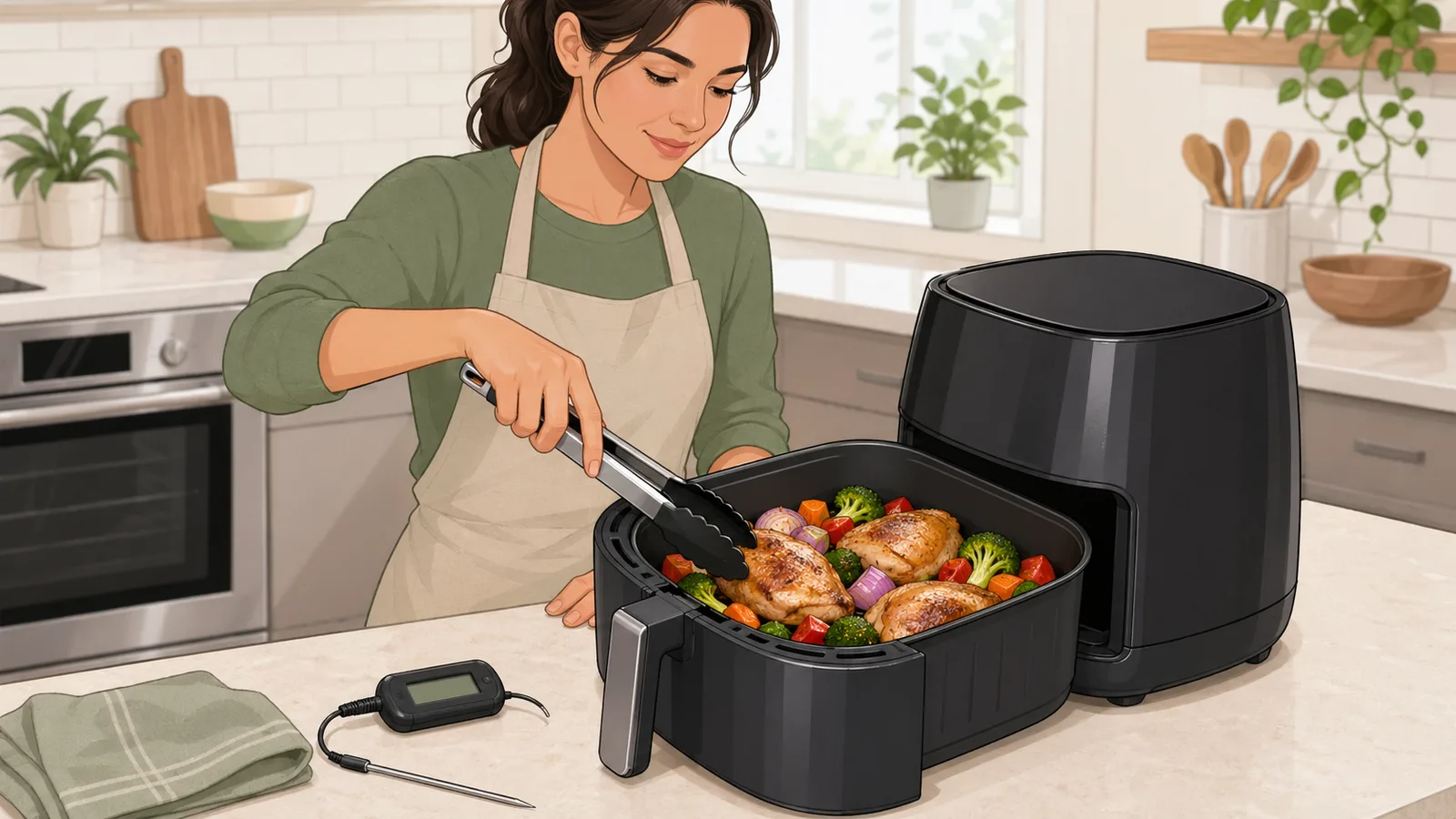
Suppose a conventional oven recipe tells you to cook breaded chicken pieces at 400F for 30 minutes. The basic air fryer shortcut would point you toward about 375F for roughly 24 minutes. But chicken pieces are thicker than frozen fries, so a cautious planner often softens the heat slightly and keeps a wider finish window instead of trusting one exact minute.
Now add a frozen-from-the-freezer starting point and a crowded basket. The neat 24-minute answer stops being realistic because the food has to thaw, the airflow is less efficient, and the centre temperature matters. In that situation the better use of an air fryer conversion calculator is to set an initial target, begin checking early, flip or shake as needed, and then verify doneness with a thermometer rather than force the food to obey the original shortcut.
Food safety and doneness still beat the timer
An air fryer conversion calculator is a planning tool, not proof that food is safe. Poultry, leftovers, and many dense proteins need thermometer confirmation because surface colour alone can be misleading, especially with breading, marinades, or sugary glazes that brown quickly. The same applies when you convert a recipe back from an air fryer to a conventional or fan oven: the finish line is still the internal temperature and visual doneness of the food, not the exact number on the timer.
For higher-risk foods, use the conversion to decide where to start and when to begin checking, then let food-safety targets decide when you stop. The FDA keeps minimum internal temperature guidance public and easy to reference, which is why this page keeps those targets visible instead of implying that a timing shortcut is enough on its own.
Some recipes do not convert cleanly. Wet-battered foods, very full casseroles, large whole roasts, and delicate cakes with exposed sugary toppings can all behave badly under aggressive circulating air. In those cases the conversion is still useful as orientation, but it should not be treated as a promise that the air fryer will match the original oven recipe one for one.
The same limitation applies across brands. Different basket sizes, fan strength, heating-element layouts, and even the darkness of the tray or basket can move the real result. That is why the page includes an appliance-profile adjustment and why the article keeps repeating the same core message: use the conversion to get close quickly, then finish the job with observation, shaking or flipping, and thermometer-based judgment where safety matters.
Frequently asked questions
What is the standard oven to air fryer conversion?
A common starting rule is to lower a conventional oven recipe by about 25F and reduce the cook time by about 20 percent. That shortcut works best for straightforward foods cooked in a single layer. It is a planning heuristic, not a universal law, so food thickness, frozen state, and basket crowding can all move the real finish point.
Do I always reduce the temperature by 25F in an air fryer?
No. The 25F reduction is the usual first step for a conventional oven recipe, but fan-oven recipes usually need a smaller change because they already use moving air. Delicate bakes may need a lower setting still, while frozen snacks sometimes tolerate a little more heat. The right answer depends on the food and the appliance, not just the headline shortcut.
How much faster does an air fryer cook than an oven?
Many everyday recipes land roughly 15 to 25 percent faster in an air fryer because the hot air is concentrated in a smaller space. That said, dense proteins, crowded baskets, and frozen food can erase much of that time saving. The safest way to use the speed advantage is to start checking early rather than assume every recipe will finish on the fastest end of the range.
Is air fryer conversion different for fan or convection ovens?
Yes. A fan or convection oven is already closer to an air fryer than a conventional still-air oven, so the jump is smaller. Many cooks use a lighter adjustment such as about 15F lower and a modest time trim instead of the full 25F and 20 percent change used for conventional ovens.
How should I convert frozen food for the air fryer?
Frozen food usually needs extra time even when the temperature stays close to the normal shortcut. The outside can look ready while the centre is still cold, especially with crowded baskets or thick coatings. Start from the converted setting, then plan a wider finish window and shake or flip more aggressively than you would for fresh food.
Should I change the air fryer conversion for thick or bone-in pieces?
Yes. Thick pieces, bone-in chicken, stuffed foods, and dense wedges usually need gentler heat and more time than thin pieces because the centre heats more slowly than the surface browns. The piece-thickness control lowers the converted temperature slightly and extends the finish window so you start from a safer, more realistic plan.
Why do baked goods sometimes burn faster in an air fryer?
Baked goods sit in moving hot air with a compact top heat source, so exposed surfaces colour quickly. Sugar, cheese, and thin pastry edges brown especially fast. That is why many bakers start lower than the generic shortcut and use foil shields, smaller pans, or earlier checks instead of pushing a cake or pastry with the same heat they would use in a large oven.
Should I preheat the air fryer before using a converted recipe?
Often yes, especially for foods where browning and timing matter. Preheating makes the first minutes of the cook more predictable and keeps the conversion closer to the result you expected. If your appliance or recipe explicitly starts cold, follow that method instead of adding heat-up time that the recipe writer did not intend.
Can I convert an air fryer recipe back to a conventional oven?
Yes, but the move usually goes in the opposite direction: add heat back and allow more time. A conventional oven normally needs roughly 25F more and a longer finish than the same air fryer recipe, while a fan oven usually lands somewhere between the two. The result is still a starting point, so colour, texture, and thermometer checks remain important.
How do I know when chicken or fish is actually done?
Use a thermometer, not just the timer. Poultry and leftovers should reach 165F / 74C, while fish is generally treated as done at 145F / 63C unless a trusted recipe or food-safety rule says otherwise. Timing shortcuts help you know when to start checking, but internal temperature is what tells you the food is safe.
Why do different air fryer brands need different settings?
Air fryers vary in basket shape, fan power, heater position, and how aggressively they brown food. A compact, hot-running basket model can crisp much faster than a gentler oven-style appliance. That is why two cooks following the same headline conversion can both be right for their own machines and why the calculator includes an appliance-profile adjustment instead of assuming every model behaves the same way.