Calculate soft-boiled, jammy, or hard-boiled egg time from egg size, fridge-cold vs room-temperature start, and altitude, with an ice-bath timing sheet.
Last updated
Egg boiling timer Use this egg boiling calculator to find how long to boil an egg for soft-boiled, jammy, or hard-boiled results. It adjusts for egg size, fridge-cold or room-temperature starts, and altitude, then keeps the full timing sheet visible so you can compare the soft-boiled egg timer, the hard-boiled egg time, and the middle ground without rerunning the calculation.
Temperature
Doneness
Start temperature
Quick altitude presets
Leave altitude at 0 for sea level or low-altitude kitchens. Increase it only if you know your cooking altitude, because the timer already accounts for the lower boiling point in mountain areas. Switch between feet and metres as needed; the calculator converts the input internally before it adjusts the boiling point.
Result
9 min 15 sec
For a large egg started fridge-cold, boil for 9 min 15 sec and ice-bath for about 4 minutes. At sea level, water boils around 212°F / 100°C.
Selected finish
Jammy / medium
Water boils around
212°F
100°C
Ice bath
4 min
Altitude
0 ft
0 m
Extra time vs sea level
0 min
Start temperature
Fridge-cold
Egg size
Large
What this means
You should get a set white with a jammy centre, which is the most forgiving middle ground. This is the best lane for ramen, grain bowls, and halved eggs where you want a jammy centre. The fridge-cold setting already adds the start-temperature adjustment. At sea level, this timing sheet stays closest to the baseline. For the cleanest repeatability, lower the eggs gently into already boiling water and move them to the ice bath without delay.
Best for ramen, grain bowls, and jammy halved eggs.
Use the highlighted row in the timing sheet when you want the exact finish you selected; the other rows show how much the soft, medium, and hard settings move as size, temperature, and altitude change.
Timing sheet
Finish
Boil time
Ice bath
Soft yolk
7 min 15 sec
2 min
Jammy / medium
9 min 15 sec
4 min
Hard-boiled
11 min 15 sec
7 min
Why altitude changes the timer
At higher altitude, water boils at a lower temperature, so eggs cook more slowly. The effect is modest at a few hundred feet and more noticeable in mountain towns, especially for jammy and hard-boiled eggs.
Kitchen note
Start timing once the eggs are in fully boiling water, then move them straight into the ice bath at the end of the boil window. If your burner struggles to hold a steady boil after the eggs go in, add a little margin or use the timing sheet as a starting point for your own pan.
Egg boiling calculator: soft, jammy, or hard-boiled timing with altitude adjustments
Use this egg boiling calculator to work out how long to boil an egg for soft-boiled, jammy, or hard-boiled results. This page also explains the main assumptions behind the egg boiling calculator result, highlights the supporting figures shown by the calculator, and helps the reader use the estimate without overstating what a quick online tool can prove.
How the egg timer works
The timer starts from a baseline for large eggs and then adjusts for three practical variables: egg size, whether the eggs go in fridge-cold or closer to room temperature, and how much altitude lowers the temperature at which water boils.
Instead of outputting just one number, the calculator also keeps the parallel timing sheet visible. That is useful when you are deciding between a jammy centre and a fully set yolk, or when you want to compare how much extra time altitude adds.
That means the page works as both a soft-boiled egg timer and a hard-boiled egg time planner, rather than forcing you to rerun the calculation from scratch whenever you change the finish you want.
Boil time = Base doneness time + size adjustment + start-temperature adjustment + altitude adjustment
Combines the main kitchen factors that shift how long the centre of the egg needs in boiling water.
Boiling point decreases as altitude rises
Higher altitude lowers the temperature of boiling water, so the eggs cook more slowly even when the water is visibly boiling.
Reading the result and choosing the finish
The main result is intentionally simple: the selected row tells you the boil time for the finish you picked, while the comparison table shows the soft, medium, and hard rows side by side. That makes it easier to decide whether you want a runny yolk, a jammy centre, or a fully set yolk before you start the pot.
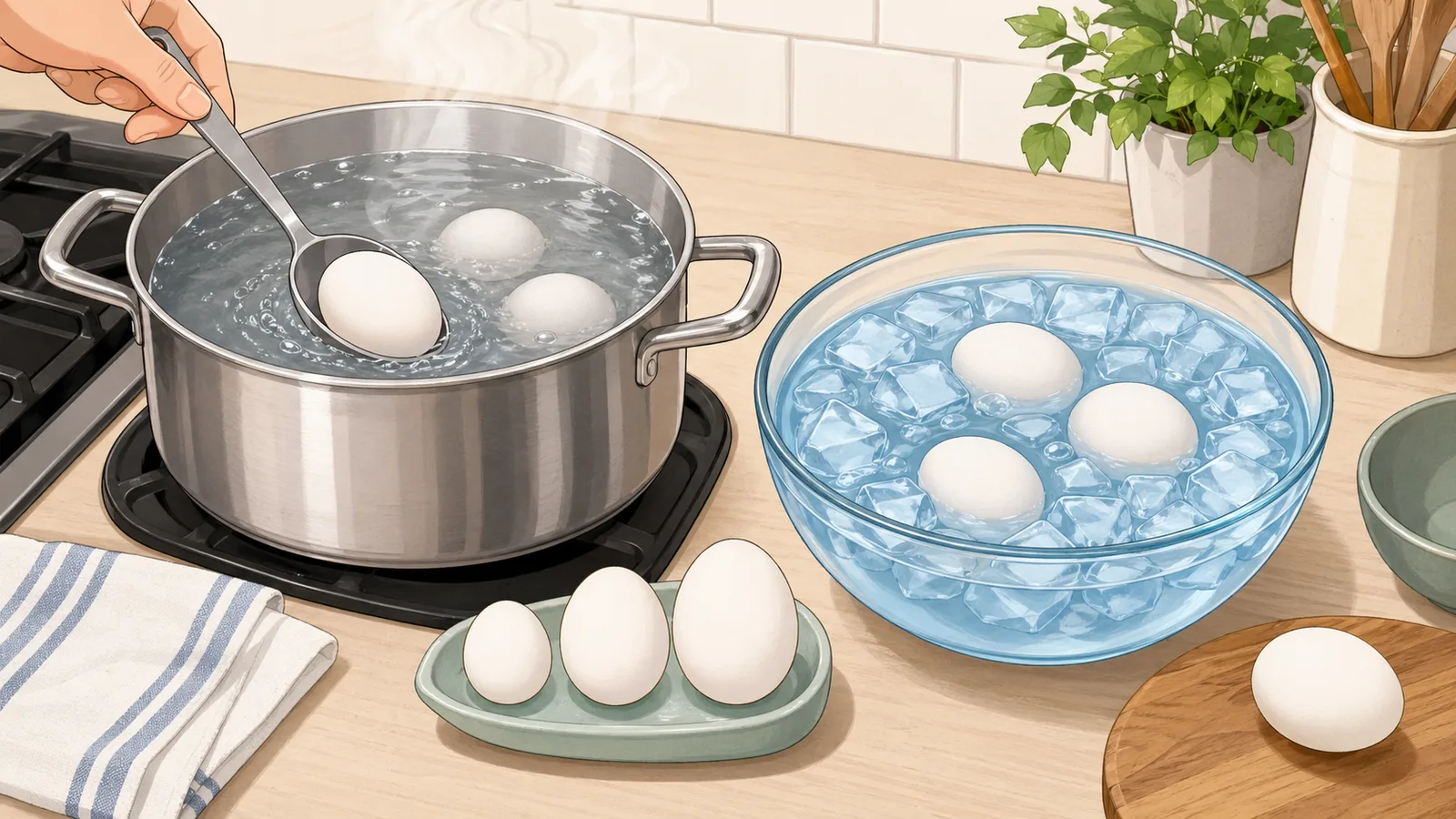
The ice-bath reminder matters because carryover cooking does not stop the moment the eggs leave the water. If you want a softer finish, move quickly from the boil to the ice bath so the interior does not keep firming up while the shell still holds heat.
This is also why the page keeps the timing sheet visible after the result updates. It is not just a stopwatch. It is a small egg boiling calculator table that helps you compare the three common doneness targets in one place.
Use the soft row when you want a runny yolk and the most delicate boil window.
Use the medium row when you want a jammy centre that still slices cleanly.
Use the hard row when you want a fully set yolk for salads, sandwiches, and meal prep.
Use the ice bath to stop carryover cooking and make peeling easier.
Why altitude changes the timer
Altitude matters because boiling water is not equally hot everywhere. As air pressure drops, water boils at a lower temperature, so the egg needs more time to reach the same internal texture even though the pot is visibly boiling.
That is why the page includes the boiling-point note alongside the altitude input. It turns a vague mountain-kitchen rule into a concrete number that explains why the same egg needs a little longer at higher elevations.
If you are comparing this page with a more general boiling-point elevation calculator, the idea is similar: the environment changes the boiling condition, and that change ripples through the cooking time.
Why a sea-level comparison is more useful than a loose altitude warning
Many egg timer pages mention altitude, but they still leave the user guessing about the practical effect. A better egg boiling calculator shows the extra time versus sea level directly, because that is how cooks think in the kitchen. You do not just want to know that altitude matters. You want to know whether Denver adds a few seconds, whether Mexico City pushes a jammy egg into a noticeably longer boil window, and whether the difference is large enough to change your routine.
That is why this page keeps the sea-level comparison visible next to the selected result. It turns altitude from a vague cooking note into a usable planning adjustment and makes the calculator much faster to trust when you move between lowland and mountain kitchens.
Worked example: large fridge-cold eggs at sea level
A common everyday scenario is a large egg pulled straight from the fridge in a sea-level kitchen. On this page, the jammy / medium target lands around 9 minutes 15 seconds of boiling plus roughly 4 minutes in the ice bath, while the hard-boiled target lands around 11 minutes 15 seconds before cooling.
That example is useful because it shows how the calculator behaves before altitude and size shifts start moving things around. If you switch the same egg to room temperature, the boil window shortens slightly. If you keep the egg fridge-cold but move the kitchen higher into the mountains, the lower boiling point adds time back in.
The practical takeaway is that the timer is a starting point built from kitchen-relevant adjustments, not a rigid promise that every pan and burner will behave identically. Once you learn how your own pot runs, you can treat the timing sheet as a repeatable baseline.
Safety and storage expectations
From a food-safety perspective, the firm-yolk, firm-white result is the conservative baseline. Soft and jammy outputs are included because cooks actively want them, but they should be treated as culinary-preference options rather than a universal safety recommendation for every household.
Hard-cooked eggs still need refrigeration after cooling. If they sit out too long or are stored warm, their safe holding time drops quickly, especially in hot kitchens or outdoor settings.
The page therefore treats the hard-boiled row as the cautious reference point, while still showing the softer timings for cooks who are deliberately aiming for a looser yolk.
How to use the timing sheet as a quick kitchen reference
Treat the calculator as a practical chart rather than a hard rule. If you know your burner runs hot, your pot is wide, or your eggs are unusually small, the sheet gives you a sensible starting point that you can tune after one or two tries.
The result cards are designed to answer the questions people usually ask in the kitchen: how long to boil an egg, how long to hard-boil eggs at altitude, and how much the starting temperature changes the boil window.
If you are comparing several kitchens or several egg sizes, keep the same doneness target selected and change one variable at a time. That makes the differences much easier to read than rerunning the calculation with every control changed at once.
The new altitude presets also make the page faster to use when you are checking a familiar city or mountain stop. That is a small feature, but it solves a real kitchen problem competitors often leave awkward: cooks usually know Denver or Mexico City faster than they know the exact feet or metres.
Ice bath time stays fixed by doneness
The cooling step is keyed to the chosen finish so the user can compare boil times without losing the stop-cooking reminder.
Higher altitude => longer boil window
The lower boiling point at altitude is the reason the same egg takes longer even though the burner setting did not change.
Frequently asked questions
How long should I boil a large egg from the fridge?
A large fridge-cold egg usually needs a little more time than a room-temperature egg. In this calculator the medium setting lands around 9 minutes 15 seconds at sea level, while the hard-boiled egg time lands around 11 minutes 15 seconds before the ice bath.
Do I start timing when the water first bubbles or when the eggs go in?
For the boiling-water method used on this page, start timing once the eggs are in actively boiling water and the boil is back under control. If adding the eggs drops the pot to a weak simmer for a while, the centre of the egg will cook more slowly than the timing sheet assumes, so you may need a little extra time.
Why do eggs take longer at high altitude?
Because water boils at a lower temperature as altitude rises. The water is still boiling, but it is not as hot as it would be at sea level, so the centre of the egg cooks more slowly.
Should I use the same time for small or jumbo eggs?
No. Smaller eggs need slightly less time, while jumbo eggs need a bit more. The calculator adjusts the selected boil window for egg size so the timing sheet stays useful across common grocery-store sizes.
How long should I ice-bath hard-boiled eggs?
The hard-boiled row uses the longest cooling reminder because the eggs retain more heat after a full boil. In this calculator the hard row suggests about 7 minutes in ice water, which helps stop carryover cooking and makes peeling easier.
Can I use this page as a quick egg timer chart?
Yes. That is one of the main reasons the page shows the three doneness rows together. It works as a practical egg timer chart for soft, jammy, and hard finishes, while still explaining why altitude and start temperature change the result.
How much longer do eggs take in Denver or other high-altitude cities?
It depends on the finish you want, but the main pattern is simple: higher altitude adds time because boiling water is cooler. This calculator now shows the extra time versus sea level directly, which is more useful than a generic warning because you can see whether the difference is minor or enough to change your routine.
What is the best timing for ramen eggs or jammy eggs?
The jammy / medium row is the best starting point for ramen eggs. It gives you a set white with a creamy centre that still feels soft rather than fully hard-cooked. The exact sweet spot still depends on altitude, egg size, and whether the eggs start fridge-cold.
Should I switch methods at very high altitude?
If you cook eggs regularly well above sea level, steaming or pressure cooking can be easier to repeat than a standard boil because they reduce some of the boiling-point variability. This page is still useful as a boiling-water reference, but the highest-altitude kitchens may prefer those other methods for consistency.