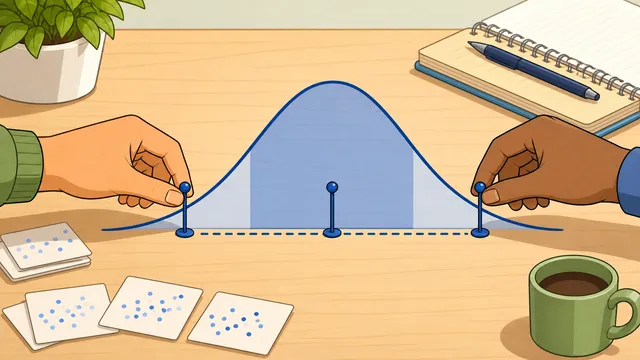
Use this central limit theorem calculator to compute standard error, sample-mean probability ranges, confidence intervals.
Last updated
Use CLT to turn population inputs into sampling-error context This planner estimates the sampling distribution of the mean, then translates it into
standard error and common confidence intervals for the sample size you entered.
About this calculator
The Central Limit Theorem states that the sampling distribution of the sample mean
approaches a normal distribution as the sample size increases, regardless of the
population distribution shape. This calculator derives the standard error and
confidence intervals for the sampling distribution.
Sampling distribution
Sampling mean
100
Standard error
2.74
Sample mean probability
93.21%
Approximate P(95 <= x-bar <= 105) using the CLT normal model for sample means.
Lower z
-1.83
Upper z
1.83
Confidence interval sheet
Level
Lower bound
Upper bound
Margin of error
90%
95.5
104.5
±4.5
95%
94.63
105.37
±5.37
99%
92.95
107.05
±7.05
Sample size comparison
n
Standard error
95% margin
95% width
10
4.74
±9.3
18.59
30 current
2.74
±5.37
10.74
50
2.12
±4.16
8.32
100
1.5
±2.94
5.88
200
1.06
±2.08
4.16
Interpretation
With a sample size of 30, the standard error of the mean is
2.74. This means repeated samples of this
size will produce sample means that typically fall within about
±5.37 of the
true population mean at 95% confidence.
Central limit theorem calculator: sampling distributions and confidence intervals
A central limit theorem calculator helps you move from population inputs to the sampling distribution of the mean. It estimates the standard error, then shows common confidence intervals so you can see how sample size changes the spread of sample means around the true population mean. That makes the CLT more practical for inference, not just a textbook definition.
The central limit theorem
The sampling distribution of the mean has a mean equal to the population mean (μ) and a standard error equal to σ/√n, where σ is the population standard deviation and n is the sample size.
Confidence intervals are constructed as μ ± z × SE, where z is the critical value for the desired confidence level (1.645 for 90%, 1.96 for 95%, 2.576 for 99%).
SE = σ / √n
Standard error of the mean. This is the specific relationship the calculator applies when building the result.
CI = μ ± z × SE
Confidence interval formula. This is the specific relationship the calculator applies when building the result.
Why sample size matters so much
The central limit theorem is often taught as a statement about normality, but for practical calculation the key effect is how sample size shrinks standard error. Because the denominator is the square root of n, larger samples tighten the sampling distribution and narrow the resulting confidence intervals.
That is why the same population standard deviation can lead to very different inference quality depending on sample size. Doubling n does not cut uncertainty in half, but it does reduce standard error enough to make interval estimates meaningfully tighter.
Worked example
Suppose a population has mean 100 and standard deviation 15, and you plan to take samples of size 30. The sampling distribution of the mean will also be centered at 100, but its standard error will be 15 / √30, which is about 2.74. That is much smaller than the original population spread because sample means vary less than individual observations.
Using that standard error, the 95% confidence interval around the mean is 100 ± 1.96 × 2.74, or about 94.63 to 105.37. If you increase the sample size, the interval gets tighter; if you reduce it, the interval widens. The calculator makes that tradeoff visible immediately.
How to use the sample mean probability range
Many people who search for a CLT calculator are not only asking for the standard error. They want to know how likely a sample mean is to fall below a cutoff, above a cutoff, or between two values. The probability range in the calculator answers that practical question by converting sample-mean cutoffs into z-scores using the sampling-distribution standard error.
For the default example, the range from 95 to 105 is about 1.83 standard errors below and above the population mean. Under the normal approximation, that places about 93.2% of repeated sample means inside the range. This is not the probability that one raw observation falls between 95 and 105; it is the probability that the average of a sample of size 30 falls there.
That distinction is the most common central limit theorem mistake. The CLT describes the distribution of sample means, not the raw population distribution itself. A narrow sample-mean interval can be highly likely even when individual observations are much more spread out.
z = (x̄ cutoff − μ) / (σ / √n)
Converts a sample-mean cutoff into a z-score on the sampling-distribution scale.
P(a ≤ x̄ ≤ b) = Φ(z_b) − Φ(z_a)
Finds the approximate probability that the sample mean falls between two bounds.
Sample size comparison: why n = 30 is not magic
The calculator includes a sample-size comparison table because n = 30 is only a rule of thumb, not a guarantee. If the population is roughly symmetric and not heavy-tailed, smaller samples may already behave reasonably. If the population is strongly skewed, bounded, or heavy-tailed, much larger samples may be needed before the normal approximation is useful.
The table keeps the mechanical part visible: standard error shrinks with the square root of n, and the 95% interval width shrinks with it. Increasing n from 30 to 120 would cut the standard error in half because √120 is twice √30. Increasing n from 30 to 300 would not make uncertainty ten times smaller; it would shrink it by about √10.
Use the comparison table as a planning aid. If changing n barely changes the decision you would make, the current sample size may be enough for the educational question. If the interval width still changes the conclusion, the CLT calculator is telling you that the sample plan may need more data or a more careful method.
Confidence intervals here are about repeated sample means
The confidence interval sheet is centered on the population mean because this page is a planning and teaching calculator. It shows where repeated sample means would tend to fall if the population mean and standard deviation were known. In a real study, you usually replace the center with your observed sample mean and use the standard error to build an interval for the unknown population mean.
If the population standard deviation is known or the sample is large enough for the approximation to be reasonable, the z-based intervals on this page are a useful model. If the population standard deviation is unknown and the sample is small, a t-based confidence interval is usually more appropriate than a z interval.
A common classroom rule of thumb is that sample sizes of 30 or more are often enough for the sample-mean distribution to look approximately normal, but the real threshold depends on the population shape. Strongly skewed or heavy-tailed populations may need larger samples before the approximation becomes comfortably reliable.
The page is therefore best used as an inference aid, not as proof that any specific dataset is normal. If the population distribution is extremely unusual or sample size is very small, more careful distributional methods may be appropriate.
Penn State STAT 414 — Penn State probability course materials covering sampling distributions and the normal approximation used in central limit theorem work.
A common rule of thumb is n ≥ 30 for the CLT to provide a good approximation, though this depends on how non-normal the population distribution is.
Does the population need to be normal?
No — that is the power of the CLT. Regardless of the population shape, the sampling distribution of the mean approaches normal as n increases.
Why is the standard error smaller than the population standard deviation?
Because the standard error measures how much sample means vary, not how much individual observations vary. Averaging pulls repeated samples closer together, so the spread of sample means is smaller than the spread of raw observations.
Does this calculator prove that my raw data are normally distributed?
No. It applies the CLT to the sampling distribution of the mean. Your original data can still be skewed or non-normal even when the distribution of sample means is approximately normal for a large enough sample size.
How do I find the probability that a sample mean falls between two values?
Enter the lower and upper sample-mean bounds. The calculator converts each bound to a z-score using z = (x̄ cutoff - μ) / (σ / √n), then subtracts the two normal cumulative probabilities. The result is an approximate probability for the sample mean, not for one individual observation.
Is n = 30 always enough for the central limit theorem?
No. n = 30 is a classroom rule of thumb, not a universal threshold. It often works reasonably for mild population shapes, but skewed, heavy-tailed, or unusual populations may require larger samples before the sampling distribution of the mean is close enough to normal.
When should I use a t interval instead of this z-based CLT interval?
Use a t interval when the population standard deviation is unknown and you are estimating it from a small sample. This page assumes the population standard deviation is known or that the sample is large enough for the z-based normal approximation to be a useful teaching and planning model.