Z-score to p-value calculator: convert z-statistics to significance levels
A z-score to p-value calculator converts a standard normal z-statistic into a probability (p-value) for hypothesis testing. It supports one-tailed and two-tailed tests, letting you quickly determine whether a z-score reaches statistical significance at common thresholds like 0.05 or 0.01.
How z-scores relate to p-values
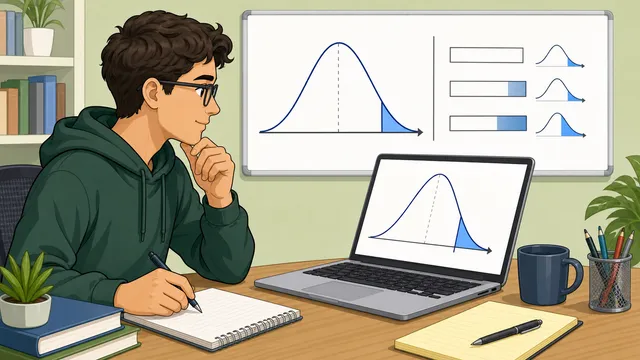
A z-score measures how many standard deviations an observation is from the mean of a standard normal distribution. The p-value is the probability of observing a z-score at least as extreme under the null hypothesis.
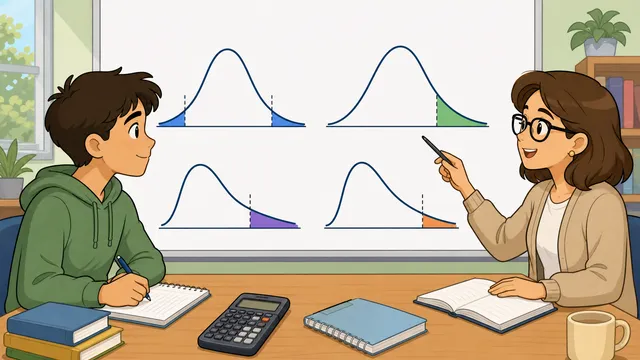
For a two-tailed test: p = 2 × (1 − Φ(|z|)), where Φ is the standard normal CDF. For a one-tailed test: p = 1 − Φ(z) for an upper tail, or p = Φ(z) for a lower tail.
p (two-tailed) = 2 × [1 − Φ(|z|)]
Two-tailed p-value from the standard normal CDF.
p (one-tailed) = 1 − Φ(z)
Upper-tailed p-value. This is the specific relationship the calculator applies when building the result.
Worked example and interpretation
A worked example helps translate the z-score to p-value calculator maths into a realistic scenario so the user can compare the headline result with a concrete set of inputs.
That matters because a result is easier to trust when the page shows how the same logic behaves in a practical case instead of leaving the formula abstract.
Using the result well
Use the z-score to p-value calculator output as a planning aid, then compare it with the assumptions, units, and caveats shown elsewhere on the page before acting on the number alone.
That extra interpretation step matters because a calculator can simplify the arithmetic but still cannot replace real-world context such as local rules, contract terms, or individual circumstances.
Frequently asked questions
What is the difference between one-tailed and two-tailed p-values?
A two-tailed p-value tests for any difference from the null hypothesis (either direction), while a one-tailed p-value tests for a difference in only one direction. The two-tailed p-value is always twice the one-tailed p-value for the same z-score.
When should I use a z-test versus a t-test?
Use a z-test when the population standard deviation is known or the sample size is large (n > 30). Use a t-test when the population standard deviation is unknown and the sample size is small. As sample size grows, the t-distribution approaches the normal distribution.
How can I check this z-score to p-value calculator: convert z-statistics to significance levels by hand?
You can usually check this z-score to p-value calculator: convert z-statistics to significance levels by applying the same conversion factor step by step on paper or with a basic calculator. That manual check is useful when you want to confirm the unit direction, decimal placement, and whether the chosen starting value matches the quantity you meant to convert.