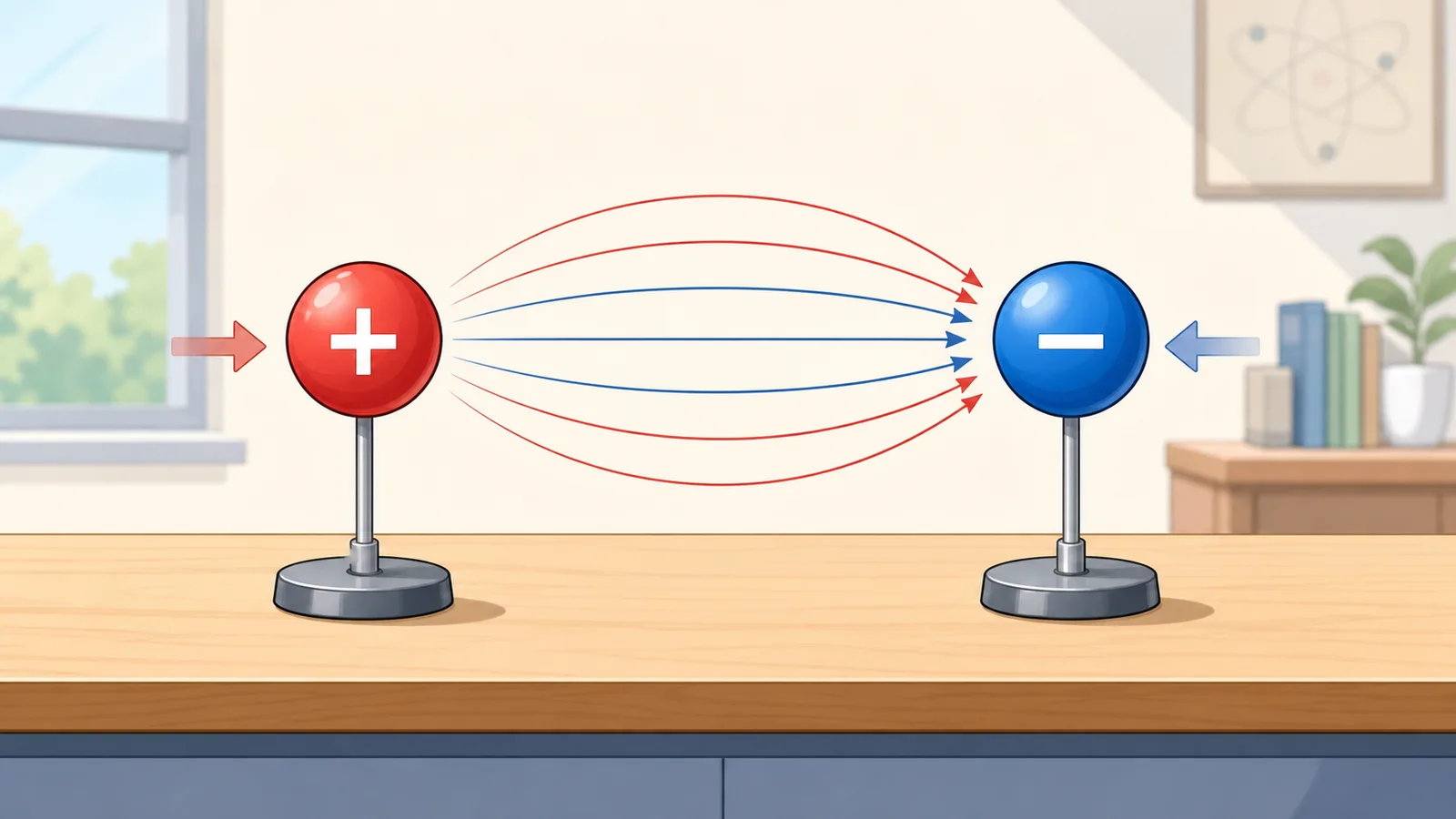
Solve electric force, one missing point charge, or separation distance with a Coulomb's law calculator that handles small charge units, known-force units.
Last updated
Coulomb's law calculator Solve the electric force between two point charges, or solve one missing charge or separation distance from the force, charge pair, and spacing.
Examples
Solve for
Solve the electrostatic force from two charges and a separation distance.
Sign convention
Charge values may be signed to represent polarity. Force mode preserves the signed charge product; missing-charge modes solve the magnitude first and then show the charge sign needed for attraction or repulsion.
Choose a solve mode and enter values Select the force setup above, then enter the known values to solve Coulomb's law.
Coulomb's law calculator: solve force, charge, or distance for point charges
A Coulomb's law calculator translates two-point-charge problems into an actionable electric force, missing charge, or separation distance result without reworking the inverse-square algebra each time. This version works as a Coulomb force calculator, electric force calculator, and point-charge distance solver while keeping charge units, force units, attraction-versus-repulsion interpretation, and electric-field context visible.
What this Coulomb's law calculator covers
This page solves the force between two point charges, or solves one missing quantity among force magnitude, one charge, or separation distance when the other three values are known.
That makes it useful for electrostatics examples, first-pass field intuition, and quick checks where unit normalization and sign interpretation are just as important as the raw number.
Force depends on charge product and inverse-square distance
Coulomb's law scales linearly with the product of the two charges and falls with the square of the separation. Doubling one charge doubles force magnitude, while doubling the distance cuts force magnitude to one quarter.
This calculator preserves the sign of the charge product in force mode so you can immediately tell whether the interaction is attractive or repulsive.
F = k × q1 × q2 / r²
Point-charge force is proportional to the charge product and inversely proportional to distance squared.
Charge-solving modes use force magnitude as the known input
When you solve for a missing charge, the entered force is treated as a magnitude and the calculator reports the solved charge magnitude with explicit polarity context. That keeps the algebra stable even when the other known charge is negative.
The distance solver similarly uses the magnitude of the charge product so opposite-charge cases still return a valid physical separation rather than failing on a negative radicand.
q = F × r² / (k × |q_other|)
Rearranging the force equation isolates one missing charge magnitude from the known force, distance, and other charge.
r = √(k × |q1 × q2| / F)
Distance follows from the inverse-square relationship when the charge magnitudes and force magnitude are known.
Choosing the right sign for a missing charge
A force magnitude alone cannot tell you whether the missing charge has the same sign as the known charge or the opposite sign. The algebra gives the charge magnitude first; the physical setup determines whether the pair should attract or repel.
For that reason, the calculator lists both signed possibilities in the result area. Use the repulsive setup when the missing charge should match the known charge's sign, and use the attractive setup when it should have the opposite sign.
Electric-field context for each point charge
Many Coulomb law calculator pages stop at the force value. This page also reports the implied electric field at each charge by dividing the force magnitude by the charge magnitude at that point.
That field view helps connect force-between-two-charges problems with electric-field intuition, where a charge experiences force because it sits in the field created by the other charge.
E = |F| / |q|
Electric field magnitude at a point follows from force magnitude divided by the charge magnitude placed at that point.
Using pC, nC, µC, mN, and other small-unit inputs
Electrostatics examples often use very small charges and forces, so the calculator accepts coulombs, millicoulombs, microcoulombs, nanocoulombs, and picocoulombs for charge values.
Known-force modes also accept newtons, millinewtons, micronewtons, nanonewtons, and piconewtons. The calculation normalizes those values to SI base units internally, then formats the result back into a readable scale.
What this calculator does not model
This calculator assumes two ideal point charges in free space. It does not model dielectric media, distributed charge geometry, shielding, or many-body interactions.
Use it as a planning and educational reference. If the real problem depends on geometry, materials, or field integration, move to the method that captures those effects explicitly.
Frequently asked questions
Why can opposite charges still produce a valid distance result?
Because the distance solve uses force magnitude and charge-product magnitude. The attraction-versus-repulsion interpretation is still reported, but the square-root step uses the physical magnitudes needed for distance.
What does a negative force mean in force mode?
A negative signed force indicates attraction because the two charges have opposite signs. A positive signed force indicates repulsion from like charges.
Can I use this for real objects instead of point charges?
Only as a rough first-pass estimate. Real objects often have distributed charge, geometry effects, dielectric surroundings, and shielding that this point-charge model does not include.
What is the difference between Coulomb force and electric field?
Coulomb force is the force between the two entered charges. Electric field describes the force per unit charge at a location, so this calculator also shows the implied field at each charge as E = |F| / |q|.
Why does the missing charge solver show attraction and repulsion sign options?
The known force input in missing-charge mode is a magnitude, so the formula solves the amount of charge first. The sign depends on whether your physical setup requires the missing charge to repel the known charge or attract it.
Which Coulomb constant does this calculator use?
It uses k = 8.9875517923 × 10^9 N·m²/C², the standard Coulomb constant used for ideal point charges in vacuum or air-as-vacuum educational approximations.
Can I enter picocoulombs or millinewtons?
Yes. The calculator accepts pC, nC, µC, mC, and C for charge, plus pN, nN, µN, mN, and N for known-force inputs in the missing-charge and distance modes.