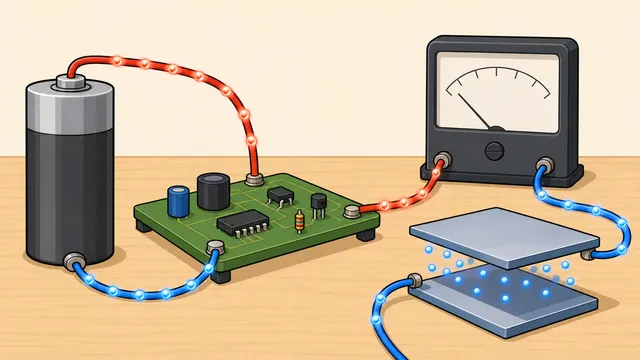
Convert surface charge density between C/m², mC/m², µC/m², nC/m², C/cm², and C/mm² with a clear SI base-value table.
Last updated
Surface charge density is charge per unit area. Use this converter when σ is written as C/m², µC/m², nC/m², C/cm², or C/mm² and you want the same value in a different reporting unit.
It is useful for electrostatics notes, charged-surface models, and capacitor-plate calculations where the area basis changes but the underlying quantity does not.
Unit guidance
C/m² is the clearest SI baseline when the source already uses metre-based notation or you want to compare against an electrostatics reference.
Add a value to convert Provide a surface charge density value and choose the source and target units to see the converted result and full equivalence table.
Surface charge density converter: C/m², µC/m², nC/m², C/cm², and C/mm² explained
A surface charge density converter rewrites the same charge-per-area value in the unit your notes, model, or lab sheet expects. It is useful when σ appears as C/m², µC/m², nC/m², C/cm², or C/mm² and you want one clean base table for comparison without changing the underlying electrostatics quantity.
What surface charge density means
Surface charge density describes how much electric charge is distributed across a surface area. In electrostatics it is commonly written as σ, and the basic relationship is charge divided by area. That makes it a natural way to describe charged plates, surface films, and idealized electrostatic boundaries.
The quantity itself does not change when you rewrite it from C/m² to µC/m² or C/cm². Only the reporting scale changes. A converter is useful because switching the numerator prefix and the area basis at the same time is easy to misread when you are comparing notes quickly.
σ = Q / A
Surface charge density equals total charge divided by the surface area over which that charge is distributed.
1 C/cm² = 10,000 C/m²
A square centimetre is one ten-thousandth of a square metre, so the per-area value grows by 10,000 when the same charge is expressed per cm².
1 C/mm² = 1,000,000 C/m²
A square millimetre is much smaller than a square metre, so the numeric value becomes much larger when the same surface charge density is stated per mm².
How the conversion works
The safest way to convert surface charge density is to translate the source into one consistent base unit first, then translate that shared base into the target unit. This page uses coulombs per square metre as the internal reference point, and every supported unit has a known relationship to that base value.
For example, converting from µC/m² to C/cm² requires two shifts at once: one for the micro prefix and one for the centimetre area basis. Instead of doing both in your head, convert the source into C/m² first, then divide or multiply into the target scale. The calculator also lists every supported equivalent so you can spot-check the order of magnitude immediately.
Suppose a source lists a value of 1 C/cm². Because 1 cm² equals 0.0001 m², that value becomes 10,000 C/m² in the base SI form. The same quantity can also be written as 10,000,000 µC/m² or 10,000,000,000 nC/m², depending on which scale is easiest to read.
The equivalence table is useful here because it shows the same value in every supported unit at once. If the original note uses a sign convention to represent charge polarity, the sign is preserved by the converter while the unit scale changes around it.
Where surface charge density shows up
Surface charge density appears in electrostatics, charged-surface models, and capacitor-plate calculations. It is also a useful intermediate when you need to compare an idealized physics setup with a lab note or printed engineering reference that uses a different unit prefix or area basis.
This page does not model the physical system behind the number. It only restates the same quantity in a different unit, so you still need the original geometry, sign convention, and source assumptions to interpret the result correctly.
Frequently asked questions
What is surface charge density?
Surface charge density is electric charge distributed over an area. It is usually written as σ and measured in units such as C/m², µC/m², C/cm², or C/mm² depending on the scale of the source and the way the result needs to be reported.
What formula defines surface charge density?
The basic formula is σ = Q / A, where Q is the charge on the surface and A is the area that charge is spread across. The converter keeps that physical quantity fixed and only changes the reporting unit.
How do I convert C/cm² to C/m²?
Multiply by 10,000. A square centimetre is one ten-thousandth of a square metre, so the same charge per unit area becomes 10,000 times larger when it is written per square metre instead of per square centimetre.
Why does C/mm² look so much larger than C/m²?
Because a square millimetre is much smaller than a square metre. If the same charge is spread over a smaller area, the numeric value per unit area has to increase even though the underlying surface charge density has not changed.
Is surface charge density the same as surface current density?
No. Surface charge density is charge per unit area, while surface current density is current per unit area. They use similar unit shapes, but they describe different physical quantities and should not be interchanged.
Can surface charge density be negative?
Yes. A negative value usually means the source is using sign to indicate charge polarity or a convention relative to a reference direction. The converter preserves that sign and only changes the unit scale.
Does this converter change the physics or only the unit?
Only the unit. It does not infer a new charge distribution, solve an electric field, or recalculate a capacitor model. It simply restates the same surface charge density in a different unit.