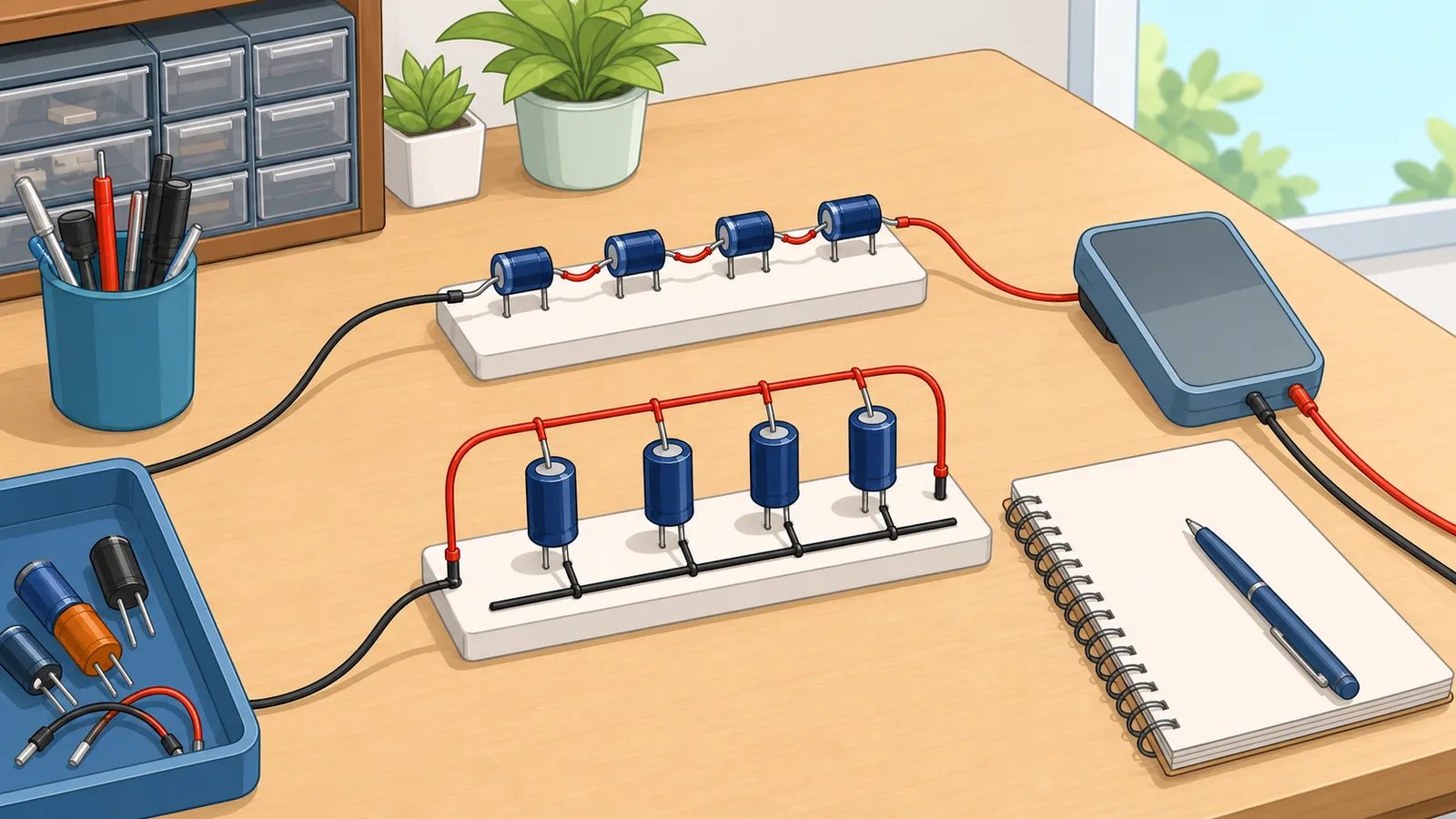
Use this series and parallel capacitor calculator to find equivalent capacitance, charge, energy, voltage split.
Last updated
Series and parallel capacitor calculator Use this equivalent capacitance calculator to compare capacitor networks in series or parallel, then add a supply voltage to see the stored charge and energy across the chain or bus.
Quick capacitor scenarios
Start with a realistic decoupling bus, a series voltage-sharing stack, or a one-capacitor sanity check, then edit values and ratings for your own circuit.
Mode
Parallel capacitors share the same voltage and add directly.
Capacitor rows
Each row adds directly to the selected network mode.
Capacitor 1
Capacitor 2
Network note
Parallel networks share one voltage and add capacitance directly. Series networks share charge and combine through reciprocals.
Equivalent capacitance
10.1 µF
2 capacitors in parallel mode produce 10.1 µF total capacitance. At 12 V, the shared voltage stays the same and total charge is 121.2 µC. Lowest voltage-rating margin: 52%.
Capacitor count
2
Supply voltage
12 V
Lowest voltage margin
52%
Total charge
121.2 µC
Stored energy
727.2 µJ
Capacitor breakdown
Each capacitor sees the same voltage, so charge and energy scale with capacitance.
Capacitor
Capacitance
Voltage
Voltage rating
Rating margin
Charge
Energy
C1
100 nF
12 V
50 V
76%
1.2 µC
7.2 µJ
C2
10 µF
12 V
25 V
52%
120 µC
720 µJ
Voltage rating check The entered ratings are not exceeded in the ideal calculation. Real parts still need tolerance, leakage, temperature, derating, and transient checks before hardware use.Formula used
Series and parallel capacitor calculator: equivalent capacitance, charge, and energy
If you are looking for an equivalent capacitance calculator, a series and parallel capacitor calculator is usually the right tool when you need more than the total alone. This version totals capacitor rows in either pure series or pure parallel mode, then adds optional charge, energy, and per-capacitor voltage context from an entered supply voltage.
What this capacitor-network calculator covers
This page accepts one or more capacitor values in mixed units and solves the equivalent capacitance for either a pure series chain or a pure parallel group.
If you also enter a supply voltage, it reports the resulting stored charge and energy and shows how voltage or charge distributes across the individual capacitors according to the selected mode.
You can also enter each capacitor's voltage rating. The calculator then compares the ideal branch voltage with the entered rating and highlights the lowest voltage margin, which is a practical check many basic capacitance calculators leave for the user to do manually.
Parallel capacitors add directly
In a parallel network every capacitor sees the same voltage, so the total capacitance is the direct sum of the branch capacitances. Larger total capacitance means more charge storage at the same applied voltage.
That makes the optional voltage-aware output especially useful for estimating total bus charge and stored energy in decoupling or energy-buffering scenarios.
For a parallel capacitor bank, the working-voltage limit is not improved by adding more capacitors in parallel. Each branch still sees the full supply voltage, so the voltage-rating check uses the same applied voltage for every rated row.
C_total = C1 + C2 + ... + Cn
Parallel capacitances add directly because each capacitor is connected across the same voltage.
Series capacitors share the same charge
In a series chain the same charge appears on every capacitor, so the equivalent capacitance is always lower than the smallest branch value. The applied voltage then splits across the chain according to the individual capacitances.
This is why the calculator shows per-capacitor voltage in series mode and per-capacitor charge in parallel mode when supply voltage is provided.
Series capacitors are sometimes used when designers want a higher effective working-voltage arrangement, but ideal voltage division is not the whole design. Real parts have leakage, tolerance, temperature drift, and transient behavior, so the rating margin shown here is a first-pass warning rather than a hardware approval.
1 / C_total = 1 / C1 + 1 / C2 + ... + 1 / Cn
Series capacitances combine through reciprocal addition rather than direct summation.
Q = C_total × V; E = 1/2 × C_total × V²
Once voltage is known, total stored charge and energy follow directly from the equivalent capacitance.
Worked scenarios built into the calculator
The default 12 V decoupling-bus example combines 100 nF and 10 µF in parallel. It returns 10.1 µF total capacitance, then shows that both rated capacitors stay below their entered voltage ratings in the ideal calculation.
The series voltage-stack preset uses 3 µF, 6 µF, and 12 µF at 230 V. The total is about 1.714 µF, but the smallest capacitor takes the largest voltage share, so the voltage-rating warning makes the design risk visible immediately.
These presets are intentionally editable. They are not recommended component values; they are quick examples that show how capacitance, charge, energy, voltage division, and capacitor voltage ratings interact.
How to read the voltage-rating margin
A positive margin means the ideal calculated branch voltage is below the voltage rating you entered. A zero margin means the calculated voltage equals the entered rating, and a negative margin means the entered rating is exceeded.
For parallel capacitors, every rated branch is compared with the supply voltage. For series capacitors, each branch is compared with its calculated voltage drop from Q = C_total × V and V_branch = Q / C_branch.
Real designs usually need additional derating and balancing checks. Treat any negative margin as a stop sign, and treat a small positive margin as a prompt to review part tolerances, surges, leakage, operating temperature, and manufacturer guidance.
What this calculator does not model
This calculator handles pure series or pure parallel capacitor groups only. It does not solve arbitrary mixed topologies, balancing resistors, ESR, leakage, dielectric absorption, tolerance spread, or breakdown limits.
Use it as a sizing and educational reference. If the design depends on balancing behaviour, transient current, or non-ideal component characteristics, move to the method that captures those effects explicitly.
For a mixed network, reduce the circuit in stages: simplify the pure series or pure parallel group you can identify first, replace it with its equivalent capacitance, then repeat until the remaining topology is clear. This page is deliberately scoped to one pure mode at a time so the branch-level interpretation stays transparent.
Frequently asked questions
Why is the equivalent capacitance smaller in series mode?
Because series capacitors must all carry the same charge, which reduces the total charge stored for a given applied voltage. The reciprocal addition rule therefore makes the equivalent capacitance lower than any individual branch.
Why do parallel capacitors all show the same voltage?
Because a parallel network connects every capacitor directly across the same two nodes. The voltage is common, while charge and energy scale with the individual capacitance.
Can I use this for a mixed capacitor ladder or filter directly?
Not with this page. It handles pure series chains or pure parallel groups only, so more complex mixed topologies need a circuit-specific reduction or simulation model.
What changes if I enter a supply voltage?
The calculator can derive stored charge and total energy from the equivalent capacitance, then show the voltage or charge context for each capacitor depending on whether you selected series or parallel mode. That makes it easier to check how the network behaves under a real operating voltage rather than only seeing the final capacitance number.
Should I expect the same voltage on every capacitor?
Only in parallel mode. In a parallel network every capacitor is across the same two nodes, so voltage is shared. In series mode the charge is shared instead, and the voltage splits across the capacitors according to their capacitance.
How do capacitor voltage ratings work in parallel?
Parallel capacitors all see the same supply voltage, so adding more capacitors in parallel does not raise the voltage rating of the group. Each capacitor still needs an appropriate voltage rating for the applied voltage, plus any design derating or transient margin.
How do capacitor voltage ratings work in series?
In the ideal series calculation, the same charge flows through every capacitor and voltage divides inversely with capacitance. The calculator checks that ideal voltage drop against each entered rating, but real series stacks may need balancing resistors or other design controls because leakage and tolerance can shift the voltage division.
Why does the series stack preset warn about one capacitor?
The smallest capacitance in a series chain gets the largest ideal voltage drop. In the built-in 3 µF, 6 µF, and 12 µF example at 230 V, the 3 µF branch exceeds a 100 V entered rating, so the calculator surfaces the risk instead of only showing the equivalent capacitance.
Is this a capacitor bank calculator?
It can be used for a simple pure-series or pure-parallel capacitor bank. It does not model mixed bank layouts, balancing resistors, ESR, ripple current, thermal limits, failure modes, or manufacturer-specific derating rules.
Can I use this for capacitor energy storage?
Yes for a first-pass ideal estimate. When supply voltage is entered, the calculator reports E = 1/2 × C × V² for the equivalent capacitance, but real energy-storage designs also need safety, discharge, insulation, current, and component-rating checks.