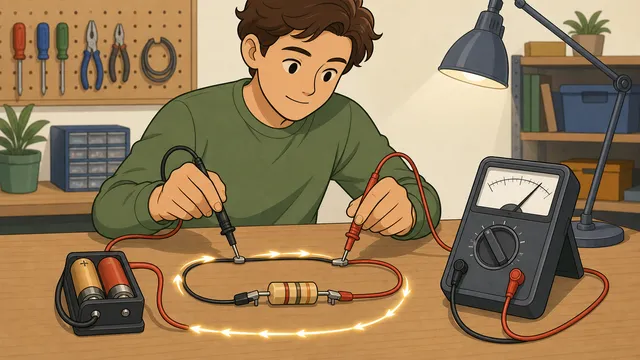
Series resistor calculator for total resistance, current through series resistors, voltage drop across each resistor, power dissipation, resistance share.
Last updated
Series resistor calculator Add two or more resistors to find the total series resistance. Enter a supply voltage to see the shared current, total power, and the voltage drop across each resistor.
Resistor rows
Each row adds directly to the series network.
Common series resistor examples
Resistor 1
Resistor 2
Network note
The total resistance is the direct sum of the valid resistor rows. If you enter a supply voltage, the same current flows through every resistor in the chain, each resistor takes a voltage drop proportional to its share of total resistance, and the voltage drops add back to the source.
Add at least two resistors Enter two or more positive resistor values to solve the series network.
Series resistor calculator: total resistance, voltage drop, current, and power
A series resistor calculator should do more than add resistor values. This page also explains the main assumptions behind the series resistor calculator result, highlights the supporting figures shown by the calculator, and helps the reader use the estimate without overstating what a quick online tool can prove.
What this series resistor calculator covers
This page accepts two or more resistor values, converts mixed ohm, kilohm, and megohm entries into ohms, and sums them into one total series resistance.
When you add a supply voltage, the live result also reports the current through the series resistors, total circuit power, each resistor's voltage drop, each resistor's share of total resistance, and a voltage ladder showing the remaining voltage after every resistor in the chain.
That makes the page useful for more than classroom arithmetic. It helps with current-limiting checks, simple bias strings, resistor ladders, and unloaded divider-style planning where the actual tap voltage matters.
Series resistors add directly
In a true series path there is only one current route, so each resistor simply adds to the total opposition seen by the source. There is no reciprocal step as there is in a parallel network.
That direct-sum behavior is why a series resistance calculator is often the fastest way to sanity-check a chain before you get into current, voltage, or thermal details. If the total resistance looks wrong, every downstream result will look wrong too.
Rtotal = R1 + R2 + ... + Rn
Equivalent series resistance is the arithmetic sum of the individual resistor values.
Current through series resistors stays the same
Once a supply voltage is known, one shared current flows through the whole chain. That current is set by the source voltage divided by total series resistance.
This is one of the most important interpretation cues in a resistors-in-series calculator. If the current changes, the network is no longer behaving like one simple series path, or an external load is changing the problem.
I = Vsource / Rtotal
Use Ohm's law on the full series loop to find the common current.
Voltage drop across resistors in series follows resistance share
Because the current is common to all resistors, each resistor's voltage drop is proportional to its resistance. A resistor that represents 40% of the total series resistance will take about 40% of the source voltage in the ideal unloaded case.
That is why resistance-share percentages are so useful. They let you reason about the circuit before you even enter voltage. Once voltage is entered, the percentage becomes a direct voltage-share check.
The live table on this page therefore surfaces both resistance share and source-voltage share instead of stopping at raw drop numbers.
Vdrop = I × Rbranch
Each resistor drop equals the common current multiplied by that resistor's value.
Vdrop / Vsource = Rbranch / Rtotal
In an ideal unloaded series chain, voltage share matches resistance share.
Worked example: 100 Ω, 220 Ω, and 330 Ω on a 12 V source
A common check is a 100 Ω, 220 Ω, and 330 Ω string on a 12 V source. Total resistance is 650 Ω, so the shared current is about 18.46 mA.
The 100 Ω resistor drops about 1.85 V, the 220 Ω resistor drops about 4.06 V, and the 330 Ω resistor drops about 6.09 V. These add back to the 12 V source, which is the Kirchhoff's voltage law sanity check the page now surfaces directly.
The same example is also a good reminder that the largest resistor in a fixed-current series string takes both the largest drop and the largest power dissipation.
Why the voltage ladder matters
Many users searching for a series resistor voltage drop calculator are not only interested in the drop across each resistor. They want to know the node voltage after the first resistor, after the second resistor, or at another tap in the chain.
That is why this page includes cumulative drop and remaining-voltage outputs. They help you inspect a resistor string as a voltage ladder instead of as isolated components.
This is especially useful for quick resistor-ladder planning, reference-bias chains, and unloaded tap checks where you care about intermediate node voltages.
Power dissipation is the practical resistor check
A series resistor calculator becomes much more useful when it reports resistor power rather than only resistance and current. In a fixed-voltage series chain, the higher-value resistor dissipates more power because the same current passes through it and it takes a larger voltage drop.
That does not replace a real wattage-rating review, but it does immediately tell you which resistor to examine first for power margin and temperature rise.
Pbranch = I² × Rbranch = Vdrop × I
Branch power rises with resistance when the current is common to the full series chain.
Ptotal = Vsource × I
Total circuit power follows from source voltage multiplied by total current.
Series resistor chain versus dedicated voltage divider calculations
A resistor string can behave like a voltage divider, but only while the tap is lightly loaded. If you draw meaningful current from a tap, the simple unloaded series result is no longer enough on its own.
That is the key distinction between a general series resistance calculator and a dedicated voltage divider calculator. This page is strongest for resistor-string planning, drop distribution, and unloaded tap checks. Loaded tap design still needs the specific divider or full circuit model.
What this calculator does not model
This calculator treats the network as ideal resistors in one simple series path. It does not model tolerance spread, temperature drift, source sag, parasitic effects, or AC/reactive behavior.
It also does not replace resistor wattage review, loaded-divider analysis, or lab measurement. Use it as a planning and educational tool, then verify performance-critical circuits against the actual operating conditions.
If a tap drives a real load, or if the network includes semiconductors, inductors, capacitors, or nonlinear behavior, use the more specific tool or a full circuit analysis instead.
Frequently asked questions
How do you calculate resistors in series?
Add the resistor values directly: Rtotal = R1 + R2 + ... + Rn. If a supply voltage is known, the current is I = V / Rtotal, and each resistor drop is V = I × R.
Why is the current the same through all series resistors?
Because an ideal series circuit has only one current path. Charge has no alternate branch, so the same current must pass through every resistor in the chain.
Why does the largest resistor get the largest voltage drop?
Because voltage drop equals the common current multiplied by the resistor value. When the current is shared, the larger resistor produces the larger drop.
Can I mix ohms, kilohms, and megohms in one series resistor calculator?
Yes. This calculator normalizes every valid input into ohms first, then solves the ideal series network from that common base.
What is the formula for voltage drop across resistors in series?
For any branch resistor, use Vdrop = I × Rbranch. If you already know source voltage and total series resistance, you can also write Vdrop = Vsource × (Rbranch / Rtotal).
Does a series resistor calculator also work as a voltage divider calculator?
It works for unloaded divider intuition and tap-voltage checks, because a resistor string divides voltage in proportion to resistance. But once the tap is loaded, the simple unloaded series result is no longer exact and you should use the divider or full circuit model.
How do I find the current through series resistors?
First add the resistors to get total resistance. Then divide the source voltage by that total resistance. The result is the same current through every resistor in the chain.
Why do the voltage drops add up to the source voltage?
That is Kirchhoff's voltage law. In a closed loop, the total source rise equals the sum of the drops around the loop, so the branch drops in an ideal series resistor chain add back to the supply.
Which resistor dissipates the most power in a fixed-voltage series chain?
The highest-resistance resistor. The current is the same through every resistor, so P = I²R means the larger resistance dissipates more power.
Can this calculator replace resistor wattage checks?
No. It estimates ideal branch power, which is useful for planning, but you still need to compare those numbers with real resistor ratings, derating policy, airflow, temperature rise, and the actual circuit.
What happens if one resistor opens in a series string?
The entire path opens, current falls to zero, and the simple series-current result no longer applies. In practice, an open component in a series chain usually stops the whole string from operating.