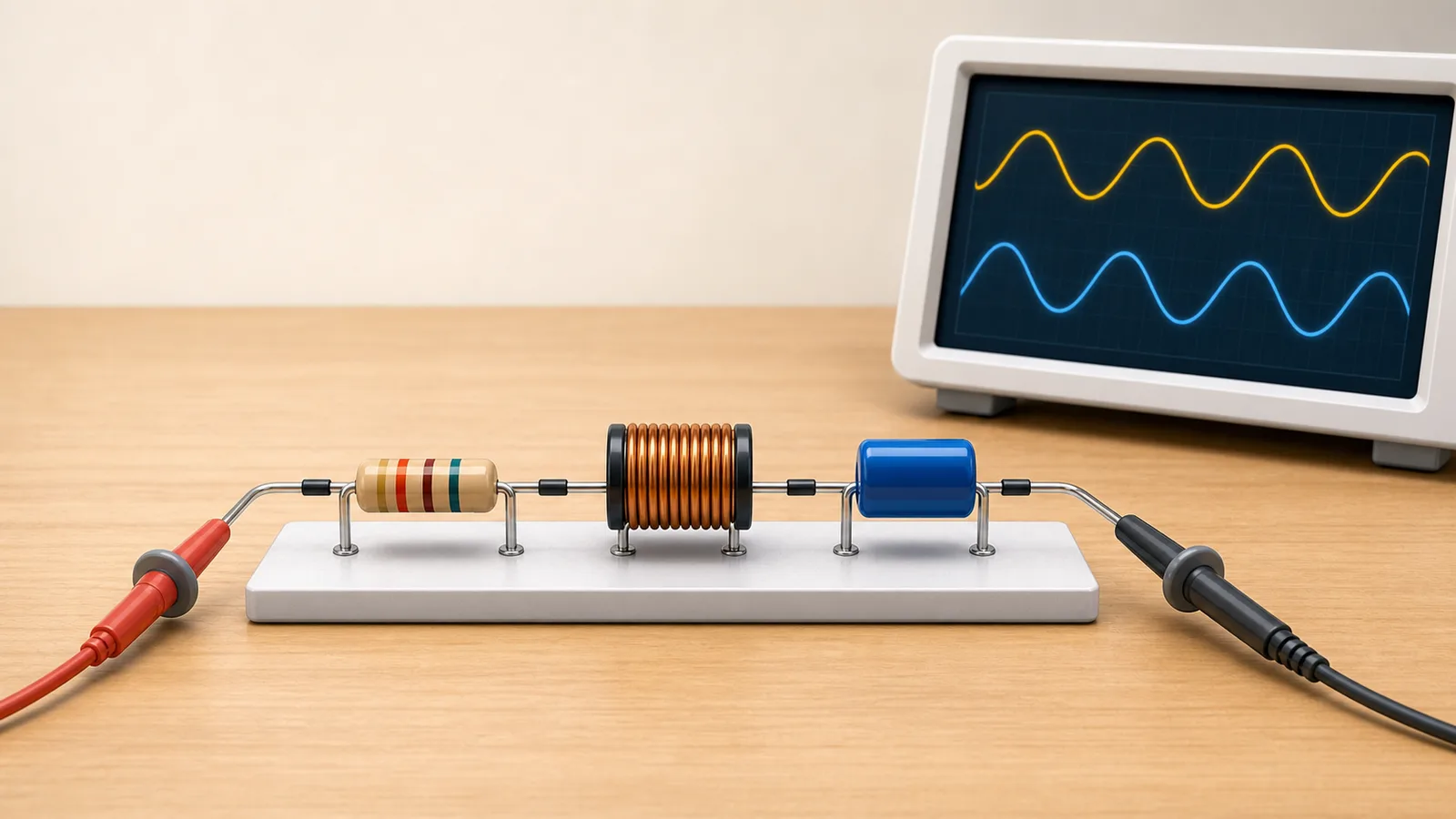
Use this RLC impedance calculator to compare series and parallel impedance, phase angle, resonance frequency, quality factor, estimated bandwidth.
Last updated
RLC impedance calculator Compare series and parallel RLC networks, including impedance, phase angle, power factor, resonance,
quality factor, and bandwidth context at a chosen operating frequency.
Mode
Solve the impedance of a series RLC network from R, L, C, and frequency.
Quick examples
A practical low-frequency series example close to resonance for power-factor intuition.
Working assumptions
This calculator assumes an ideal linear network at one sinusoidal frequency. Entering a supply voltage adds
current and power context, but it does not model ESR, winding loss, source impedance, tolerance spread, or
parasitic elements.
Equivalent impedance
48.3099 Ω
The operating point sits above resonance, so inductive reactance dominates, current lags voltage, and the power factor drops below unity.
Operating above resonance Above resonance, inductive reactance outweighs capacitive reactance in a series branch.
Equivalent impedance
48.3099 Ω
Phase angle
13.3727° lagging
Power factor
0.9729 lagging
Resonant frequency
50.3292 Hz
Quality factor
0.6728
Estimated bandwidth
74.8028 Hz
Inductive reactance
37.6991 Ω
Capacitive reactance
26.5258 Ω
Net reactance
11.1733 Ω
Supply voltage
120 V
Supply current
2.484 A
Apparent power
298.1 VA
Real power
290 W
Reactive power
68.9401 VAR
Frequency ratio
1.1922x f₀
Operating frequency compared with the resonant frequency.
Offset from resonance
+19.2151%
Useful when checking how quickly a series branch will move away from minimum impedance.
Formula used
Z = √(R² + (X_L - X_C)²)
X_L = 2π × 60 Hz × 100 mH = 37.6991 Ω
X_C = 1 / (2π × 60 Hz × 100 µF) = 26.5258 Ω
X = X_L - X_C = 11.1733 Ω
Z = √(R² + X²) = 48.3099 Ω
f₀ = 1 / (2π√(LC)) = 50.3292 Hz
Resonance context
f₀ = 1 / (2π√(LC)) = 50.3292 Hz
For a series RLC branch, resonance is where impedance collapses toward the resistive floor and current peaks for a fixed source voltage.
The estimated quality factor of 0.6728 implies an idealized bandwidth of 74.8028 Hz around the resonant peak or dip. Use that as a selectivity clue, not as a substitute for a full swept-frequency model.
RLC impedance calculator: series or parallel impedance, phase angle, resonance, Q
An RLC impedance calculator is most useful when you need to understand both magnitude and behaviour, not just one reactance value in isolation. This version compares series and parallel RLC networks at the chosen frequency, then adds phase, power factor, resonance, quality factor, estimated bandwidth, and optional current or power context from an entered supply voltage.
What this RLC impedance calculator covers
This page takes one resistance, one inductance, one capacitance, and one operating frequency, then solves the equivalent impedance of either a series or parallel RLC network.
That makes it useful for AC design checks, resonance intuition, and first-pass troubleshooting where you need to see whether inductive or capacitive behaviour dominates at the stated frequency. It also gives a practical answer to searches such as RLC impedance calculator, impedance calculator for series and parallel circuits, and RLC resonance calculator.
Series and parallel RLC networks combine differently
In a series RLC branch the resistance and net reactance combine directly into one impedance triangle, so the impedance magnitude follows from resistance and reactance together. That is why series resonance shows up as a minimum-impedance condition.
In a parallel RLC branch the calculation works through admittance instead. Conductance comes from the resistor branch, susceptance comes from the inductor and capacitor branches, and the equivalent impedance is the reciprocal of the resulting admittance magnitude. In an ideal parallel tank, resonance appears as a maximum-impedance condition.
X_L = 2πfL; X_C = 1 / (2πfC)
Inductive reactance rises with frequency, while capacitive reactance falls with frequency.
Z_series = √(R² + (X_L - X_C)²)
Series impedance comes from the resistor and the net reactance at the operating frequency.
Parallel impedance is found from conductance and susceptance rather than direct resistance-plus-reactance addition.
Resonance marks the balance point
The resonant frequency is the point where the inductor and capacitor balance each other in magnitude. At that frequency the reactive terms cancel in the ideal series case, and the circuit moves closest to purely resistive behaviour. In the parallel case, the source sees the strongest impedance peak when the susceptive terms balance.
Comparing the entered operating frequency with resonance helps explain the reported phase angle and power factor. Below resonance a series branch tends to look more capacitive, while above resonance it tends to look more inductive. A parallel network flips the engineering intuition because the source is seeing the reciprocal admittance result rather than the direct series impedance sum.
f₀ = 1 / (2π√(LC))
The standard resonance equation shows where inductive and capacitive effects balance for the stated L and C values.
Why quality factor and bandwidth matter
Competitor tools often stop at impedance and phase angle, but real design work also needs some idea of selectivity. The quality factor Q measures how sharply the network resonates. Higher Q usually means a narrower response around resonance and a more selective or more lightly damped network.
The bandwidth estimate on this page is an idealized resonance-width cue derived from Q. It is helpful for quick tuning checks, filters, tanks, and impedance-matching intuition, but it is not a full swept-frequency simulation. Real bandwidth depends on losses, coupling, source and load impedance, and any extra components not represented in the single-branch ideal model.
Q_series = ω₀L / R = 1 / (ω₀CR)
Ideal series-RLC quality factor at resonance.
Q_parallel = R / (ω₀L) = ω₀CR
Ideal parallel-RLC quality factor for the simple resistor, inductor, and capacitor network modeled here.
Bandwidth ≈ f₀ / Q
Useful ideal estimate of how quickly the resonant behaviour falls away around the center frequency.
How to interpret the operating point
The page shows the operating frequency as a ratio of resonance and also as a percent offset from resonance. Those two values answer different practical questions. The ratio tells you whether the network is running below, at, or above the tuned point. The percent offset tells you how far away that operating point is in relative terms.
That is especially useful when you are iterating around a prototype or checking whether a measured frequency is still inside the intended design window. In a low-Q network, a modest offset may barely change the impedance. In a high-Q network, the same offset can move the circuit well away from its most selective or most efficient region.
What this calculator does not model
This calculator treats the network as an ideal single-resistor, single-inductor, single-capacitor AC model. It does not estimate component tolerance, inductor DCR, capacitor ESR, saturation, dielectric loss, skin effect, source impedance, distributed parasitics, or any coupling to neighbouring stages.
Use it as a planning and educational reference. If the design is sensitive to losses, thermal limits, control stability, damping, self-resonance, or high-frequency parasitics, move to the measurement or simulation method that captures those effects explicitly.
Worked example
Suppose a series branch uses 47 Ω, 100 mH, and 100 µF at 60 Hz with a 120 V source. The inductive reactance is higher than the capacitive reactance, so the branch operates above its 50.33 Hz resonant point and looks inductive overall. The equivalent impedance is about 48.31 Ω and the phase angle is about 13.37° lagging.
The power factor remains close to unity because the branch is not far from resonance, but the calculated Q and bandwidth show that the response is still fairly broad rather than sharply tuned. This is exactly the kind of situation where an impedance magnitude by itself is not enough. You also want the phase and resonance context before deciding whether the network is acting like a tuned stage, a damped branch, or just an AC load with some reactive bias.
Frequently asked questions
What does an RLC impedance calculator do?
It calculates the total impedance of a resistor, inductor, and capacitor network at a chosen frequency. This page also reports phase angle, power factor, resonance, quality factor, estimated bandwidth, and optional current or power when a supply voltage is entered.
What is the difference between series and parallel RLC impedance?
In a series RLC branch the resistor and net reactance combine directly, so resonance drives the impedance toward a minimum. In a parallel RLC network the source sees the reciprocal of the total admittance, so resonance appears as a maximum-impedance condition in the ideal model.
Why does the phase angle change sign?
Because the sign depends on whether inductive or capacitive behaviour dominates at the chosen frequency. Inductive dominance produces a lagging phase angle, while capacitive dominance produces a leading one. The sign also depends on whether you are reading a series branch directly or interpreting the equivalent result of a parallel network.
Why does resonance matter if I only need impedance?
Because resonance explains where the reactive terms balance. Knowing how close the operating frequency is to resonance helps you understand whether the network will look more resistive, inductive, or capacitive, and whether small frequency shifts are likely to matter.
What is Q in an RLC circuit?
Q, or quality factor, is a measure of how selective or lightly damped the resonant response is. Higher Q means a narrower ideal bandwidth around resonance and a steeper change in behaviour as the frequency moves away from the tuned point.
How does this page estimate bandwidth?
It uses the idealized approximation bandwidth ≈ f₀ / Q. That is a practical first-pass estimate for a simple RLC network, but the real bandwidth of a built circuit also depends on losses, loading, coupling, and other parasitics.
Can I use this for real filter or tank circuits directly?
Only as a first-pass estimate. Real RLC circuits also depend on winding resistance, capacitor losses, source loading, layout parasitics, and frequency-dependent component behaviour that this ideal model does not include.
Why is the parallel RLC impedance not simply R plus reactance?
Because parallel components add as admittances, not as direct impedances. The resistor contributes conductance, the inductor and capacitor contribute susceptance, and the calculator converts that combined admittance back into an equivalent impedance seen by the source.
Can I use the supply-voltage output to size real power parts?
Treat it as a planning figure only. The current and power results assume the entered source voltage is applied directly to the ideal equivalent network. Real component heating, tolerance drift, crest factor, and waveform shape may change the safe operating point.