Screen infant weight, length, and head-circumference percentiles against WHO growth standards for babies under 2 years.
Last updated
WHO baby growth percentile calculator Screen infant weight, length, and head circumference against WHO standards for babies under 2 years, with an optional corrected-age workflow for preterm babies.
Quick examples
Units
Sex on growth chart
Chart age basis
How to get a more trustworthy result
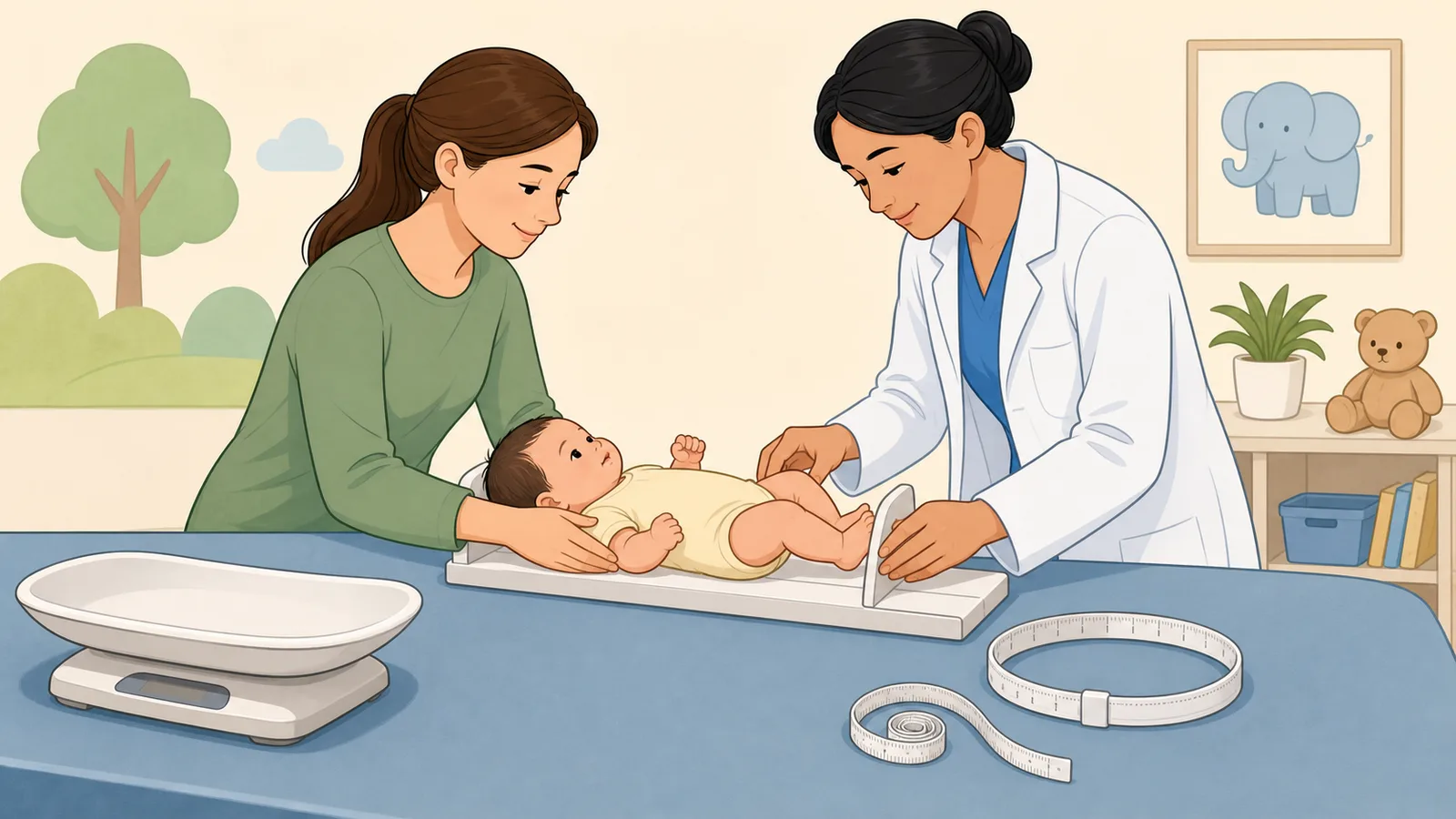
Measure length lying down: infant recumbent length is not the same as standing height after age 2.
Use corrected age when needed: for a preterm baby, clinicians often compare growth with the due-date-adjusted age rather than chronological age alone.
Read trend, not one number: percentile lines matter most when you compare repeated measurements over time.
Result
Growth measures near expected range
WHO growth-standard screening for a 5 months 29 days old girl.
Growth measures near expected range These WHO growth-standard percentiles sit within the broad expected spread for infants under 2 years. The most useful check is whether the baby continues to track along a broadly consistent curve over time.
5 months 29 days
Chart age used
5 months 29 days
Chronological age
None
Age correction
4.76 pts
Percentile spread
Age context
Charted using chronological age because no preterm correction was applied.
Measurements tell a fairly consistent story
The entered percentiles sit relatively close together, which is usually easier to interpret than widely separated measurements. Clinicians still care most about repeated growth checks and feeding history.
Weight percentile
55th percentile
Weight-for-age sits near the expected WHO range for age and sex.
Measured
7.4 kg
50th percentile
7.28 kg
Z-score
0.14
Difference from median
1.69%
Weight is close to the median line for this chart age, so the bigger question is whether the baby keeps following a broadly steady curve over time.
Chart line
Weight
3rd percentile
5.8 kg
50th percentile
7.28 kg
97th percentile
9.17 kg
Length percentile
56th percentile
Length-for-age sits near the expected WHO range for age and sex.
Measured
66 cm
50th percentile
65.64 cm
Z-score
0.16
Difference from median
0.54%
Length is close to the median line for this chart age, so the bigger question is whether the baby keeps following a broadly steady curve over time.
Chart line
Length
3rd percentile
61.39 cm
50th percentile
65.64 cm
97th percentile
69.9 cm
Head circumference percentile
60th percentile
Head circumference-for-age sits near the expected WHO range for age and sex.
Measured
42.5 cm
50th percentile
42.16 cm
Z-score
0.26
Difference from median
0.8%
Head circumference is close to the median line for this chart age, so the bigger question is whether the baby keeps following a broadly steady curve over time.
Baby growth percentile calculator guide: WHO infant charts, corrected age
A baby growth percentile calculator compares infant measurements with the World Health Organization (WHO) growth standards used for babies from birth to younger than 2 years.
Why this page uses WHO baby growth charts under age 2
CDC and the American Academy of Pediatrics recommend using the WHO child growth standards for babies from birth to younger than 2 years. That is why this baby growth percentile calculator is built around WHO infant chart data rather than the CDC 2-to-20-year references used for older children.
This matters because infant growth changes quickly in the first two years. Weight, recumbent length, head circumference, and weight-for-length are the main chart families for this age group, while BMI-for-age is usually not the headline screening tool for babies. Parents often search for baby percentile calculator, infant growth percentile calculator, or baby growth chart calculator, but the practical intent is usually the same: compare a real measurement with the right infant standard.
What this baby percentile calculator actually measures
The calculator converts the entered birth date and measurement date into an exact chart age in days, selects the matching WHO LMS reference row for that age and sex, then converts each measurement into a z-score and percentile. Weight, length, and head circumference are reported separately because each one answers a different screening question.
Weight helps show current mass relative to age. Length helps show linear growth. Head circumference adds information about skull and brain growth that weight and length alone do not show. A result near the 50th percentile is not automatically better than one near the 10th or 90th percentile. A healthy baby can track steadily on many different lines.
z = (((measurement / M)^L) - 1) / (L × S)
WHO LMS transformation used to convert each infant measurement into a z-score.
percentile = Φ(z) × 100
Each z-score is converted into percentile rank for age and sex.
corrected age = chronological age - weeks born early
When a preterm baby is charted by corrected age, the chart age is adjusted back from chronological age.
Corrected age matters for preterm babies
One of the biggest gaps in many competing tools is corrected age. If a baby was born preterm, chronological age can make the baby look smaller on a standard term-infant chart than is fair. Corrected age adjusts for how early the birth happened and is often the better anchor for growth-chart interpretation during infancy.
This calculator therefore lets you switch from chronological age to corrected age when prematurity matters. That is a practical advantage because many parents search for preterm baby percentile calculator or corrected age growth chart help even when the page title they type is simply baby growth percentile calculator. The calculation still does not replace specialist neonatal follow-up, but it removes one common interpretation error.
For preterm babies, ask whether the chart should use chronological age, corrected age, or a dedicated preterm chart at the current stage of follow-up.
Use the same age basis consistently when comparing one visit with another.
If the corrected-age result and chronological-age result tell very different stories, bring both to the clinician rather than assuming either one is the whole answer.
Why one isolated percentile can mislead
A baby in the 5th, 25th, 50th, or 90th percentile can be completely healthy. Concern rises less from one isolated position and more from the pattern over time: crossing percentile bands repeatedly, a drop in weight gain that does not match length, feeding difficulty, vomiting, dehydration, chronic illness, or developmental concerns.
AAP guidance on growth faltering emphasises that z-scores and repeated growth measurements are more informative than a single percentile. That is why this page shows separate results for multiple measurements and explains whether those measurements are telling a broadly consistent story or a more spread-out one.
Weight, length, head circumference, and weight-for-length are not interchangeable
A baby growth chart calculator often gets used as if weight percentile alone settles the question. It does not. A relatively low weight percentile with an average length percentile can mean something different from a baby whose weight and length track together. That is also why clinicians often look at weight-for-length in infants instead of relying on BMI-for-age.
This calculator focuses on three measurements that parents commonly have from a check-up, but it does not replace weight-for-length assessment or a clinician's full review. If weight seems out of step with length, or if the percentile spread between entered measures is wide, that is a prompt for context rather than self-diagnosis.
How to measure baby length and head circumference more accurately
For babies younger than 2 years, length should be measured lying down as recumbent length rather than standing height. That distinction matters because recumbent length is usually a little longer than standing height, and using the wrong method can shift the percentile.
Head circumference should be measured at the widest practical front-to-back part of the head using a flexible tape. Even small measurement errors can move a percentile, especially when a baby is near the chart edges. If the result seems surprising, the first step is often to re-measure rather than assume the chart is wrong.
Worked example: a term baby near the middle of the WHO chart
A girl measured at almost 6 months with weight 7.4 kg, length 66 cm, and head circumference 42.5 cm lands close to the middle of the WHO chart. In the live calculator, that works out to roughly the mid-50s for weight and length and around the 60th percentile for head circumference.
That kind of result is usually reassuring when the baby is feeding well and previous checks follow a similar curve. The useful takeaway is not that the baby is near the median, but that the measurements are reasonably aligned with one another and not obviously pushing in conflicting directions.
Worked example: why corrected age changes the story for a preterm baby
Imagine a baby born at 32 weeks who is now several months old. If you chart only the chronological age, the baby may appear to sit much lower on the term-infant WHO curves. If you apply corrected age, the comparison shifts closer to the age the baby would have been if born at term.
That does not make the baby automatically healthy or automatically fine, but it often makes the growth chart interpretation fairer. It is one reason a good infant growth percentile calculator should let the user choose corrected age when prematurity is part of the history.
When the result needs prompt clinical review
Use the output as a screening reference, not as a diagnosis. Faster review is worth seeking if a measurement is well outside the expected band, if several measurements are moving in opposite directions, if the baby is not feeding well, is vomiting repeatedly, has diarrhoea or dehydration, or seems less alert or developmentally off track.
The chart is only one layer of information. Birth history, gestational age, previous measurements, feeding pattern, symptoms, and exam findings matter more than a single web result. That is especially true for preterm babies, babies with congenital conditions, and babies whose growth has changed quickly over a short interval.
Use this calculator only for babies younger than 2 years.
Recheck measurements if a result looks implausible or sharply different from the last visit.
Take both the percentile result and the raw measurements to the clinician if you are worried.
Urgent symptoms or dehydration need clinical care regardless of percentile.
Frequently asked questions
What age range does this baby growth percentile calculator cover?
It is designed for babies from birth up to, but not including, 2 years of age. That matches the WHO infant growth-standard approach recommended by CDC and AAP for this age group.
Do I need all three measurements to use the calculator?
No. The calculator can screen whichever measurements you have, but weight, length, and head circumference together give a much more useful infant growth snapshot than a single number on its own.
Should I use corrected age for a premature baby?
Often yes. If the baby was born preterm, corrected age can give a fairer comparison on the growth chart than chronological age alone. This page includes an optional corrected-age mode for that reason.
Why can a baby's percentile change from one visit to the next?
Percentiles can change because the measurement itself changed, because the age basis changed, because of small measurement differences, or because the baby's growth velocity genuinely shifted. Repeated checks over time matter more than one isolated move.
Is a low percentile automatically a sign something is wrong?
No. Some healthy babies track on lower centile lines. The bigger concern is usually a drop across percentiles over time, poor feeding, weight loss, illness, or a mismatch between weight, length, and head circumference.
Is a high baby percentile automatically a problem?
No. Many healthy babies track on higher centile lines. A high percentile needs context from the rest of the growth pattern, symptoms, and whether the increase is rapid or persistent rather than just one high reading.
Why does this page use WHO rather than CDC charts for babies?
For children younger than 2 years, CDC and AAP recommend WHO growth standards. CDC child growth charts are generally used from age 2 onwards, so this infant tool stays inside the WHO range intentionally.
Why does head circumference matter in a baby growth check?
Head circumference adds information that weight and length do not show. Clinicians use it alongside the rest of the growth pattern to screen whether skull and brain growth look broadly consistent over time.
Why does the calculator ask for length rather than height?
Babies under 2 years are usually measured lying down, which is recumbent length rather than standing height. Using the right measurement type helps keep the percentile comparison fair.
What should I do if my baby is close to age 2?
Once the child reaches age 2, the growth-chart system changes. That transition can change the apparent percentile even when nothing is wrong, so use an older-child growth calculator and interpret any shift with caution.