Use this bedridden patient height calculator to estimate older-adult surrogate stature from knee height when standing height cannot be taken safely.
Last updated
Bedridden patient height calculator for older-adult knee-height estimates Use this bedridden patient height calculator when standing height cannot be taken safely. It turns knee height into an estimated stature, keeps the original 60 to 90 year validation band visible, and helps you document the result honestly for nutrition, geriatrics, or chart review.
Older-adult surrogate stature
Use knee height when standing height cannot be taken safely, then document the output as
an estimated stature rather than a measured height.
Bedside examples
Measurement reminder
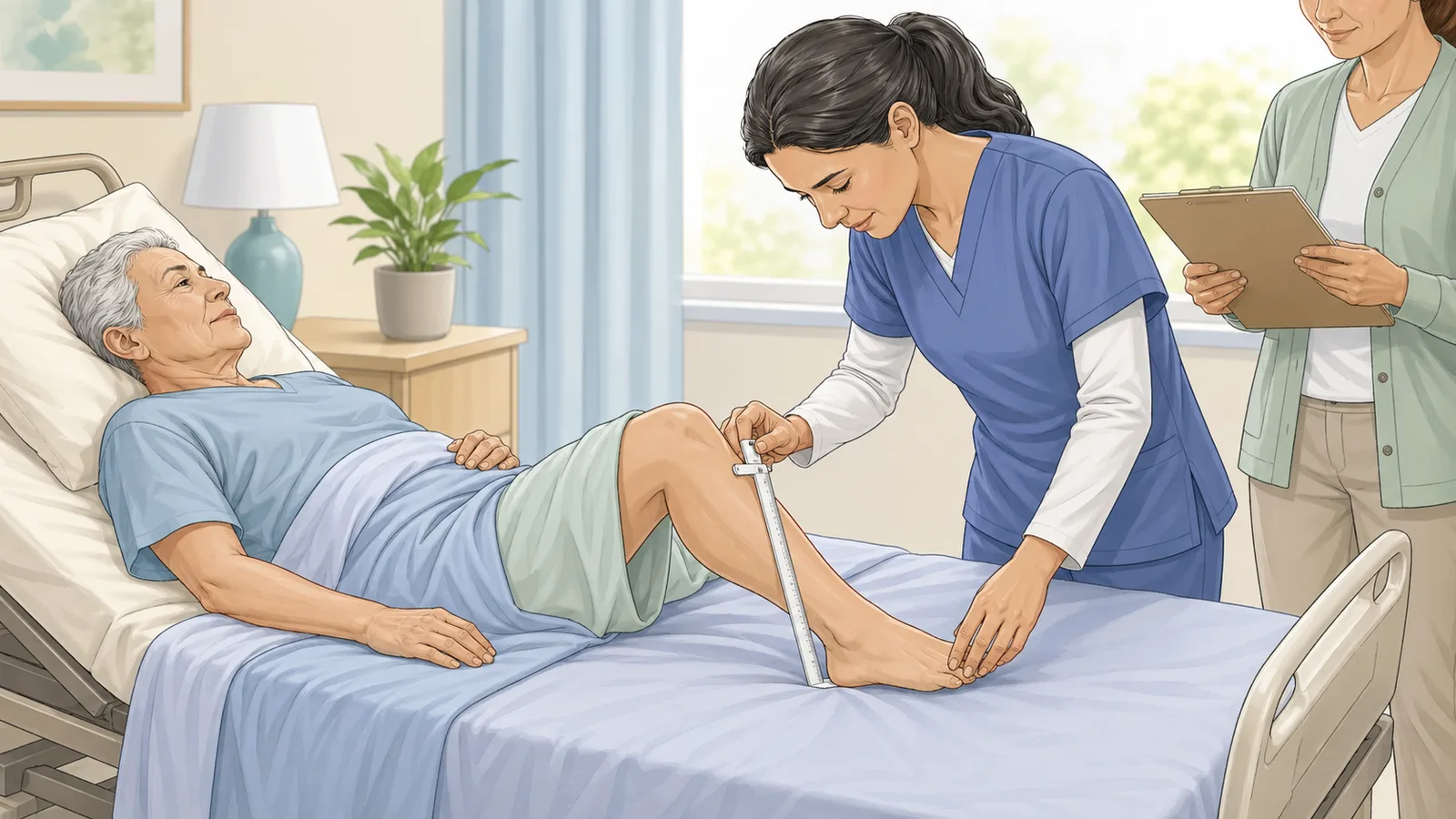
Position the patient supine or seated with the knee and ankle near 90°, then measure from
the heel to the front of the thigh just above the knee. Repeat the reading if the first
measure looks inconsistent.
Validated use case
This calculator is meant for older adults when direct standing height is not practical
because of immobility, kyphosis, pain, or bed confinement. It is not a general all-ages
height reconstruction tool.
Enter older-adult knee-height details Provide age, sex, and knee height to estimate surrogate stature for a person who cannot be measured standing.
A bedridden patient height calculator is most useful when you need a defensible bedside height estimate for an older adult who cannot be measured standing.
Why knee height is used when standing height is not practical
Standing height can be hard to obtain in older adults who are bed confined, have major mobility limitations, or cannot stand upright safely because of pain, frailty, or postural change. In those situations, clinicians often need another way to estimate stature so they can interpret BMI, nutrition screening, or other size-based calculations.
Knee height is useful because it remains relatively stable with aging compared with total standing height. That makes it a practical surrogate measurement when direct stature is unavailable or unreliable.
This is why searches such as bedridden patient height calculator, knee height calculator, and estimate height from knee height usually come from nutrition, geriatrics, or hospital workflows rather than general consumer curiosity. The point is not to guess someone's "real" height casually; it is to support a measurement problem that appears in bedside care.
Competitor pages often frame the same idea as a surrogate height calculator or a way to estimate height without standing. Those phrases point to the same clinical need: a bedside estimate that is honest about its limits and more useful than a guess based on appearance alone.
Why this page is intentionally narrow
This calculator is intentionally limited to older-adult knee-height equations rather than pretending to cover every substitute body measurement for every population. That narrower scope is more honest and better aligned with the evidence used to support the result.
The estimate is therefore best viewed as an older-adult bedside nutrition tool. It is not a universal all-ages stature reconstruction method, and it should not be overinterpreted outside the population in which the equations were developed and validated.
That narrowness matters because published equations differ by population. The original Chumlea work covered adults aged 60 to 90 years, while later NHANES III work produced race- and sex-specific US equations. A universal page that hides those differences would look easier to use, but it would also be less trustworthy.
Some competitor calculators ask for race or combine several surrogate measurements in one screen. That can be useful when the implementation is tied to a specific clinical protocol, but it can also make the result look more certain than the evidence supports. This page deliberately labels the result as a Chumlea-style knee-height estimate and explains when another method should replace it.
Female older-adult bedside equation This is the specific relationship the calculator applies when building the result.
How the estimate should be interpreted
The headline output is an estimated stature with a likely range rather than a promise of exact measured height. That framing is important because the original Chumlea paper reported roughly ±6 cm individual error bounds, which is large enough to matter when a clinical decision sits close to a cut point.
In practical terms, that means a bedside estimate may be useful for nutrition screening, pressure-injury risk workflows, or dose review that needs a reasonable size estimate, but it should still be documented as estimated height from knee height rather than as direct standing height.
The page also distinguishes between use inside the original 60 to 90 year development band and more cautious older-adult extrapolation above 90 years. That does not make the estimate unusable for very old adults, but it does mean the confidence around the result should be lower and clinician review should weigh more heavily.
Worked example: what 50 cm of knee height means
Suppose a 78-year-old woman has a knee height of 50 cm. Using the equation on this page gives an estimated stature of about 157.7 cm, or roughly 5 feet 2 inches, with a likely range extending about 6 cm either side of the central estimate.
That range matters more than the exact decimal place. If the estimate is being used for BMI, nutrition screening, or chart review, it is better to record it as an estimated older-adult stature from knee height and remember that the true direct height may sit somewhat above or below the headline figure.
Competitor pages often stop at the formula, but users also need the operational step after the arithmetic: document the value honestly, and replace it with measured standing or recumbent length later if that becomes feasible.
Likely range ≈ estimated height ± 6 cm
Rule of thumb for the likely range on this page
When this page should not be used casually
A generic online estimate is not a substitute for bedside assessment in complex medical cases. Severe contractures, unusual limb proportions, amputation, edema, or measurement technique problems can all distort the result.
Knee height also is not the only alternative method. In some older adults, ulna length, demi-span, or recumbent length may be more practical, which is one reason systematic reviews advise against acting as if one equation is universally correct for every older population.
If the estimate will influence medical nutrition assessment, medication dosing, or another clinical decision, use it only as a structured aid and confirm the approach with a qualified healthcare professional rather than treating the online output as the final answer.
How to use a knee height calculator at the bedside
A knee height calculator works best when the leg can be positioned close to the usual 90-degree bend and the heel-to-thigh landmark is easy to see and repeat. If the first reading looks inconsistent, repeat the measure rather than locking in a questionable number.
The result should then be documented as estimated stature from knee height, not as a measured standing height. That wording matters because nutrition screening, chart review, and dose context all become easier to interpret when the surrogate method is made explicit.
When to choose another surrogate height method
If the patient has major contractures, cannot tolerate the positioning, has an amputation, or has unusual limb proportions, the knee-height estimate may be less trustworthy than another surrogate method. In those cases, recumbent length, demi-span, or ulna-based estimation may be a better fit than forcing this page to answer every case.
That is the main difference between a bedside height calculator and a clinical protocol: the calculator can guide the estimate, but the clinician still chooses the measurement method that best matches the patient in front of them.
Frequently asked questions
Why does the calculator ask for age and sex?
Because the knee-height equations are age- and sex-specific. Those inputs are part of the regression itself, not decorative profile fields, so changing them changes the estimated stature. That is also why a generic page that asks only for knee height would be too simplistic for older-adult clinical use.
Can I use this for younger adults or for every older population?
Not confidently. This page is intentionally framed around older-adult use because the original equation family was developed for adults aged 60 to 90, and later studies show that equations can vary by population. For younger adults or different anthropometric populations, another equation or direct measurement method may be more appropriate.
Is the result exact enough for BMI or nutrition screening?
It can be useful for those tasks when standing height is unavailable, but it remains an estimate with meaningful individual error. Use it as estimated stature from knee height, keep the likely range in mind, and do not treat it as interchangeable with a directly measured standing height when a narrow threshold or high-stakes decision is involved.
What if the patient cannot tolerate the position or has contractures, edema, or amputation?
That is a reason to step back rather than force this page to fit. The knee-height method assumes a recognisable 90° knee and ankle position and reasonably standard limb proportions. If that is not possible, a clinician may choose recumbent length, ulna length, demi-span, or another protocol-specific surrogate instead.
Is this the same as estimating height without standing?
Yes, in practical search terms it is. The calculator is designed for the older-adult bedside situation where standing height cannot be taken safely, so it turns a knee-height measure into an estimated stature that can be used for screening and documentation support.
Should I record the answer as measured height or estimated stature?
Record it as estimated stature from knee height. That makes it clear to the next clinician that the number came from a surrogate method rather than a direct standing measurement, which is important when the result is used in BMI or nutrition workflows.
How do I know when to use a different surrogate?
Choose a different surrogate when the knee-height position is not feasible or when the limb proportions are unusual enough to make the estimate less credible. In those cases, recumbent length, demi-span, or ulna-based estimation may be a better fit than pushing the knee-height equation past its limits.
Why does this calculator not ask for race or ethnicity?
Later NHANES III equations show that race- and ethnicity-specific models can differ, but applying those equations responsibly requires choosing the right population reference and documenting the method. This page keeps the public calculator narrower: it uses the older-adult Chumlea knee-height equations, highlights the population limitation, and tells users to treat the result as estimated stature rather than a universal clinical truth.