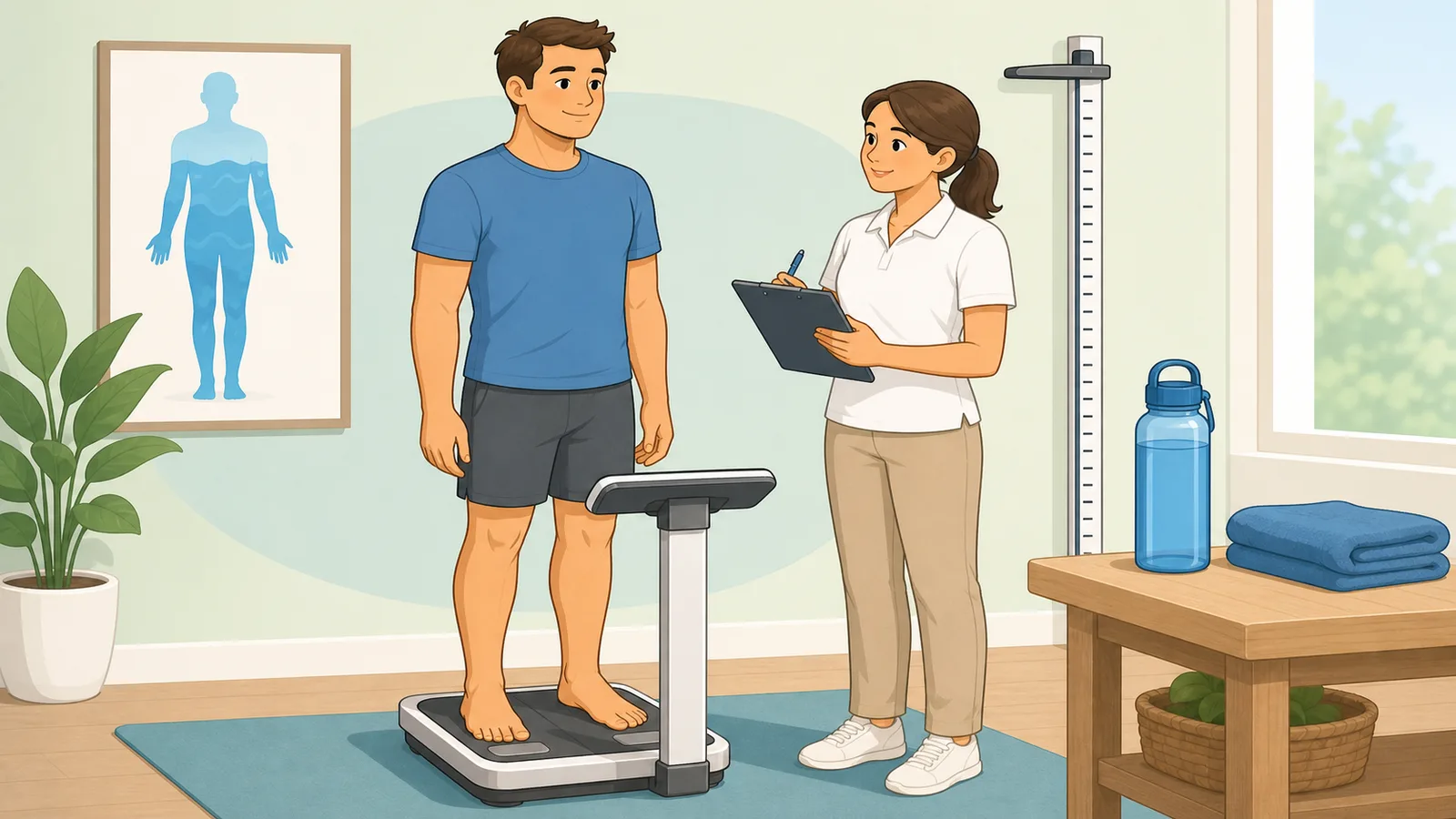
Estimate total body water and body-water percentage with Watson or Hume-Weyers, then compare formula spread, body-water rule-of-thumb context.
Last updated
Body water worksheet
Estimate total body water, body-water percentage, and formula spread from one profile.
This total body water calculator uses Watson or Hume-Weyers to estimate TBW, then compares the result with a simple body-water rule of thumb so you can see the likely range rather than one isolated number.
Built for total body water and body-water percentage questions Use the live result as body-composition context. Total body water is not the same thing as a daily water-intake target or a clinical hydration measurement.
Units
Quick example profiles
Watson example using the classic 30-year-old, 80 kg, 180 cm profile.
What this estimate is good for
Use TBW to understand body-water percentage, body composition, and formula spread. Do not use it to diagnose dehydration or decide how much fluid to drink during illness or medical treatment.
Result
45.9 L
Using Watson (1980), the estimate is 45.9 L of total body water, about 57.4% of body weight.
Body-water percentage
57.4%
Water mass
45.9 kg
Non-water mass
34.1 kg
Intracellular (~60%)
27.5 L
Extracellular (~40%)
18.4 L
Reference band
50–65%
Common adult male reference band This estimate sits inside a common adult reference band, which is usually more useful as body-composition context than as a statement about day-to-day hydration status.
Formula comparison
Watson (1980)45.9 L
Hume-Weyers (1971)44.8 L
60% body-weight rule of thumb48 L
The two formulas differ by about 1.1 L for the same body-size inputs. The selected formula is below the simple rule-of-thumb estimate by 2.1 L.
The two formulas stay fairly close for these inputs, which supports using the result as a broad educational range rather than a single exact value.
Body-composition context
This estimate sits within a common adult middle range and should be read as body-composition context rather than a hydration target.
Total body water is not a drinking target This estimate describes how much water your body contains, not how much water you should drink today. Daily fluid needs depend on sweat loss, climate, illness, and medical context.
Total body water estimates are based on population regression equations and may vary by ±10–15% for individuals. These are not diagnostic values. Clinical assessment of hydration status should use direct measurement methods.
Total body water calculator guide: body-water percentage, Watson formula
A total body water calculator estimates how much of your body mass is water by using population equations such as the Watson formula or Hume-Weyers formula.
What total body water is measuring
Total body water, usually shortened to TBW, is the total amount of water contained in the body. It is usually shown both as an absolute amount in litres and as a percentage of body weight. Those two views answer slightly different questions: litres tells you total scale, while body-water percentage helps compare different body sizes more fairly.
This is why a total body water calculator is mostly a body-composition tool rather than a hydration-status tool. The estimate tells you how much water your body is likely carrying overall, not whether you are acutely dehydrated today. That distinction is important because many users land on a TBW page expecting a water-intake target or a dehydration score, which this kind of equation cannot provide.
Body water percentage is strongly shaped by lean mass, age, sex, and body-fat proportion. Lean tissue carries much more water than adipose tissue, so two people with the same scale weight can still have meaningfully different TBW estimates.
Why body-water percentage changes with age and body composition
Body-water percentage usually trends higher in leaner, more muscular adults and lower in adults carrying more body fat. That is not because one person is necessarily drinking more water than another. It happens because different tissues hold different proportions of water.
Age matters too. Older adults usually carry a smaller water fraction than younger adults because body composition changes over time, especially when lean mass falls and fat mass rises. That is why the same body weight can produce a lower total body water percentage later in life, even before you think about illness or fluid balance.
This also explains why simple “normal TBW” claims should be treated cautiously. There is no one perfect value for all adults. A better question is whether the estimate fits the person's body-composition context and whether several reasonable formulas tell a similar story.
Lean mass generally carries more water than fat mass.
Older age usually lowers total body water percentage.
Body-water percentage is a composition clue, not a hydration prescription.
Equation-based estimates are more useful for comparison than for diagnosis.
Watson formula, Hume-Weyers, and simple rule-of-thumb estimates
Most online total body water calculators use one of two classic anthropometric formulas. Watson is the more recognisable equation and includes age for men, which makes it more sensitive to age-related body-composition change. Hume-Weyers is older and relies on height and weight without the same age term.
A few calculators also use a simple rule of thumb, often around 60% of body weight for men and 50% for women. That shortcut can be useful for quick context, but it is less tailored than Watson or Hume-Weyers. A stronger calculator shows all three perspectives so the user can see whether the result is stable or whether it swings noticeably depending on method.
That comparison is valuable because the spread between formulas is part of the story. If Watson, Hume-Weyers, and a broad rule of thumb stay close, the estimate is more reassuring as a general educational range. If they spread out meaningfully, you should treat the result as less precise and more context-dependent.
Using the Watson formula for a 30-year-old male who weighs 80 kg and stands 180 cm tall, the estimate is about 45.9 litres of total body water. Against body weight, that works out to about 57.4% body water. That is a typical educational example because it shows how litres and percentage tell the same story in two useful formats.
For the same inputs, Hume-Weyers gives a nearby but not identical result. A simple 60% body-weight rule of thumb would place total body water at about 48 litres. Seeing those values side by side is more useful than seeing only one output because it immediately shows the likely spread between shortcut and formula-based estimates.
The live calculator also splits the estimate into rough intracellular and extracellular compartments. That is helpful for physiology context, but remember that the compartments are derived from a broad proportion of estimated TBW rather than directly measured in your body.
Body water compartments and what the split means
Total body water is commonly divided into intracellular fluid and extracellular fluid. Intracellular fluid sits inside cells and accounts for the larger share of total body water. Extracellular fluid includes plasma, interstitial fluid, and smaller specialised compartments outside the cells.
A simple online TBW calculator can only estimate those compartments by applying a broad proportion to the total. It does not directly measure intracellular water, extracellular water, oedema, or fluid overload. The compartment split is therefore best read as anatomy context rather than as a diagnostic fluid study.
This is one of the main reasons a body-water calculator should stay honest about what it is doing. It can help users understand the structure of body fluids, but it cannot replace direct clinical measurement or specialist body-composition methods.
Total body water vs hydration status and daily water intake
This is the most common misunderstanding around TBW pages. Total body water is not the same thing as a recommendation for how much water to drink today. A person can have a relatively high body-water percentage because they are lean, muscular, or younger, yet still need more fluid on a hot training day than another person with a lower baseline TBW percentage.
Hydration status changes over hours and days with sweat loss, illness, sodium balance, climate, and recent fluid intake. Total body water changes more slowly and is tied much more closely to body composition. That is why a TBW estimate is not a dehydration diagnosis, not a sports-drink prescription, and not a substitute for a dedicated water-intake or hydration calculator.
Competitor pages often blur these ideas by mixing body-water percentage with hydration recommendations. The safer approach is to keep them separate: use TBW for body-composition context, and use a separate hydration or water-intake calculator when your real question is how much to drink.
A total body water estimate is useful when you want a broad body-composition checkpoint, a way to compare formulas, or an explanation for why body-water percentage differs between people of the same weight. It is also useful in educational contexts where Watson and Hume-Weyers are discussed, such as dialysis, physiology, or body-composition coursework.
It can also be useful as a comparison layer beside other metrics. If body-fat percentage, lean-mass estimates, and total body water all tell a similar story, confidence in the general direction improves. The key word is direction. These are still estimates, not direct body-fluid measurements.
When a TBW equation is less reliable
Population equations become less reliable at body-composition extremes and in clinical states that materially change fluid balance. Obesity, very high muscularity, oedema, pregnancy, acute illness, and some chronic conditions can all widen the gap between formula output and measured body water.
This matters especially in settings such as fluid management, dialysis planning, and serious dehydration assessment. A good calculator should say that clearly rather than suggesting a precision the formula cannot deliver. If the decision is clinically important, direct measurement and professional interpretation matter more than a free online estimate.
Another limitation is that home body-composition devices and anthropometric formulas do not always agree with each other. If several methods disagree materially, the right conclusion is usually not that one must be exact. It is that total body water is harder to estimate precisely than many quick calculators suggest.
This page can estimate total body water, convert it into body-water percentage, compare Watson and Hume-Weyers, and show how the result differs from a simple body-weight rule of thumb. It can help explain why age, sex, lean mass, and adiposity change body-water percentage.
It cannot diagnose dehydration, determine electrolyte needs, prove a disease state, or replace direct measurement. If your real question is whether you are fluid depleted, fluid overloaded, or medically unwell, use clinical assessment rather than an anthropometric TBW estimate.
Frequently asked questions
What is total body water in simple terms?
Total body water is the total amount of water contained in your body. It is usually shown in litres and as a percentage of body weight, which is why people also search for body-water percentage or water weight.
What is the difference between total body water and body-water percentage?
Total body water is the absolute amount of water in the body, usually shown in litres. Body-water percentage expresses that same amount as a share of body weight, which makes it easier to compare people of different sizes.
Which formula does this calculator use?
This page uses the Watson formula and Hume-Weyers formula. It also compares the selected result with a simple body-weight rule of thumb so you can see how stable the estimate is across methods.
Why do Watson and Hume-Weyers give different answers?
They are different anthropometric equations built from different fitted relationships. Watson includes an age term for men, while Hume-Weyers relies on height and weight alone. A small spread is normal and reminds you that TBW formulas are estimates, not direct measurements.
What counts as a normal body-water percentage?
There is no single perfect percentage for all adults. Common adult male values are often higher than common adult female values, and older adults usually sit lower than younger adults. The more useful question is whether the estimate fits age, sex, and body-composition context rather than whether it matches one exact number.
Does this calculator tell me how much water I should drink?
No. Total body water is not the same thing as a daily water-intake target. It estimates how much water your body contains, not how much fluid you should consume on a given day.
Can drinking more water raise my total body water percentage?
Temporarily, fluid intake can change body water, but your baseline total body water percentage is driven much more by body composition than by one day of drinking. Healthy kidneys and hormones regulate short-term fluid balance closely.
Why can two people with the same weight have different total body water?
Because body composition matters. A leaner, more muscular person usually carries a higher percentage of water than a person of the same weight with more body fat.
When is a total body water formula less reliable?
Equation-based estimates become less reliable in unusual body compositions, obesity, pregnancy, oedema states, severe illness, and clinical situations where direct measurement would be preferred.
Does a lower total body water percentage always mean dehydration?
No. A lower body-water percentage often reflects body composition or age rather than acute dehydration. That is why TBW should be read as body-composition context and not as a stand-alone hydration diagnosis.