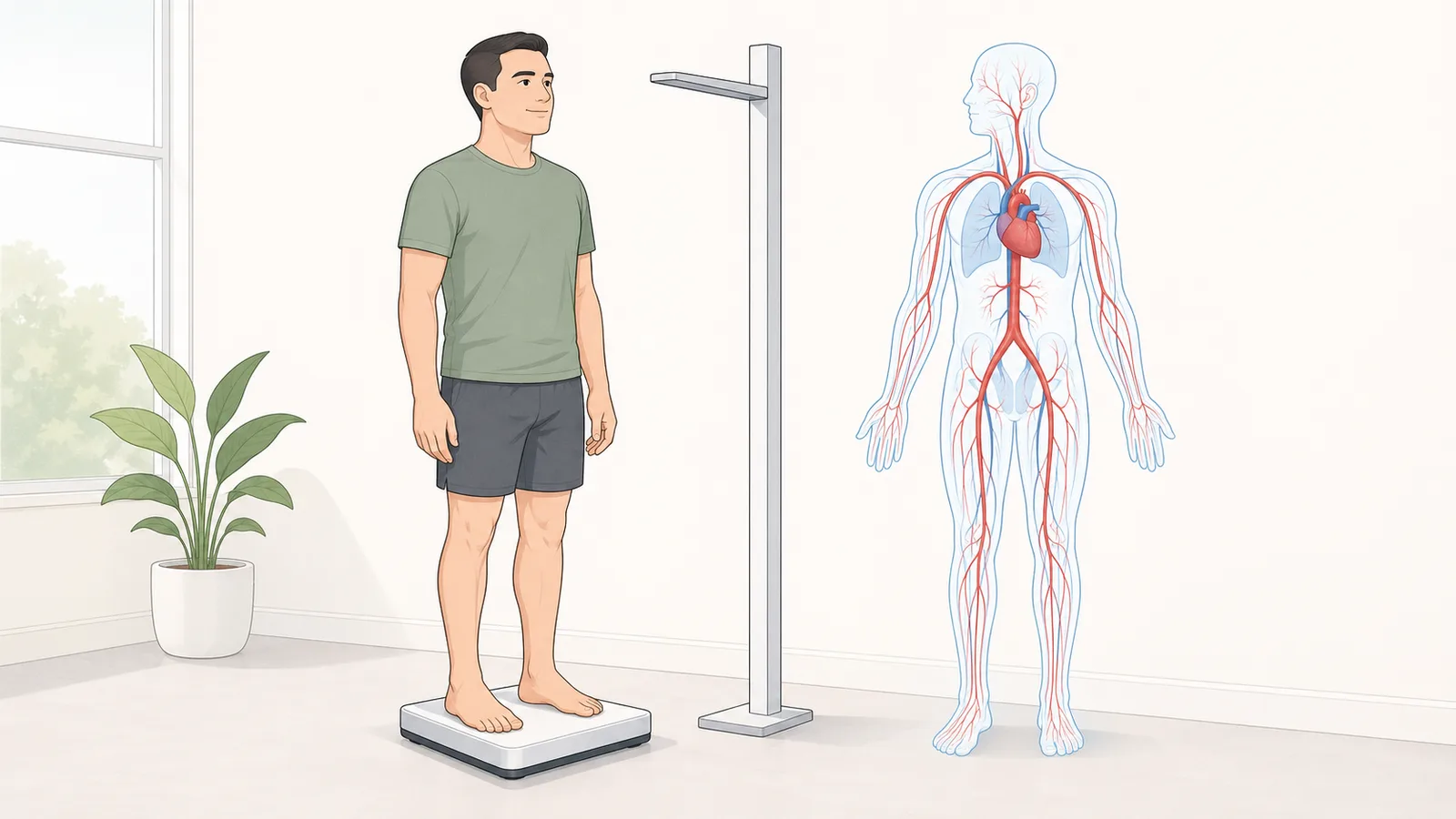
Blood volume calculator for estimated circulating blood volume, mL/kg context, formula comparison, hematocrit split, and loss-threshold guidance.
Last updated
Blood volume calculator for estimated circulating blood volume Compare Nadler and Gilcher estimates to understand total blood volume, mL/kg context, and how loss-threshold percentages scale from the same estimate. This is educational only, not a clinical measurement.
Units
How to read the estimate
Nadler is usually the stronger general-purpose estimate because it uses both height and weight. Gilcher is a simpler weight-based shortcut and works best as a comparison rather than a replacement for direct clinical measurement.
Quick adult profile presets
Use these to sanity-check the calculator, then replace them with your own measurements. They are example profiles, not reference standards.
Estimated blood volume
5.09 L
Nadler estimate for a male adult at 75 kg and 178 cm.
mL total
5,088
mL / kg
67.8
Plasma
2.8 L
Red cells
2.29 L
Split basis
Red-cell and plasma rows use the entered 45% hematocrit. They are contextual estimates, not measured blood components.
Formula comparison
The alternate formula is shown for context only. The difference is not a sign that one value is “wrong”; it shows how estimate choice changes the output.
Formula
Estimate
Context
Nadler
5.09 L / 5,088 mL
Selected estimate
Gilcher
5.25 L / 5,250 mL
+162 mL
(+3.2%)
Loss thresholds from this estimate
These rows are educational context only. They are not suitable for trauma, surgical, or transfusion decisions.
Threshold
Blood loss
Litres
10% of estimate
509 mL
0.51 L
15% of estimate
763 mL
0.76 L
20% of estimate
1,018 mL
1.02 L
Common fixed-volume comparisons
These rows keep the volume fixed and ask what share of your estimated blood volume it represents. That makes standard-donation and round-number comparisons easier to understand than percentages alone.
Scenario
Volume
% of estimate
Remaining volume
Small lab/sample contextUseful for understanding why small fixed volumes look very different from whole-blood donation volumes.
250 mL
4.9%
4.84 L
Typical whole-blood donation contextA standard whole-blood donation is a meaningful but still fractional share of total circulating volume.
470 mL
9.2%
4.62 L
Round 500 mL comparisonHelpful for comparing the estimate with common rule-of-thumb discussions of half-litre blood loss.
500 mL
9.8%
4.59 L
1 litre contextShows how quickly the percentage rises once the fixed volume reaches 1 litre.
1,000 mL
19.7%
4.09 L
Same-height body-size sensitivity
This keeps sex, formula, and height fixed while shifting body weight. It helps show how much the estimate moves with body size rather than making the current result look more precise than it is.
Profile
Weight
Estimate
Difference
10 kg lighter-322 mL versus the current estimate at the same height and formula.
65 kg
4.77 L
-322 mL
Current body weightReference point for the current input values.
75 kg
5.09 L
0 mL
10 kg heavier+321 mL versus the current estimate at the same height and formula.
85 kg
5.41 L
+321 mL
Medical caution Blood volume estimates are population-level approximations. Actual blood volume varies with fitness, pregnancy, hydration, altitude, and illness, so these values are not suitable for clinical decision-making without direct measurement.Donation context At this body size, a typical whole-blood donation volume of about 470 mL is roughly 9.2% of the estimate, leaving about 4.62 L still circulating.
A blood volume calculator estimates circulating blood volume, often called estimated blood volume (EBV), from height, weight, and sex using established anthropometric formulas.
What estimated blood volume means
Blood volume refers to the total blood circulating in the body, including both plasma and red blood cells. In adult physiology references, the estimate is often discussed as litres for the whole person and as mL/kg so that body-size comparisons are easier to interpret.
That is why estimated blood volume is most useful for context. It helps explain why two adults of different size are not expected to have the same circulating volume, but it does not replace direct clinical assessment when exact measurement matters.
Why blood volume calculators compare Nadler and Gilcher
The two formulas included here are intentionally different. Nadler uses height and weight together, which makes it a better general-purpose anthropometric estimate for adults. Gilcher is a simpler weight-based shortcut that can be handy as a comparison, but it makes fewer distinctions between people of the same body weight.
Showing both results makes the page more useful because it exposes the spread between a more anatomy-aware estimate and a faster weight-based rule of thumb. That comparison is often more informative than a single output number with no context.
How blood volume formulas work
Most simple calculators use anthropometric equations such as Nadler or broad weight-based heuristics such as Gilcher. Nadler is generally preferred for everyday estimation because it uses both height and weight rather than weight alone.
These formulas were developed by comparing direct measurements with body-size variables in adult populations. That makes them practical and fast, but still population equations rather than personalised measurements.
A stronger calculator also shows the alternate formula alongside the selected one. That is useful because it highlights the range of plausible outputs rather than implying that one anthropometric shortcut is exact enough for clinical use.
The corresponding Nadler equation for adult women, with different fitted coefficients.
Gilcher = weight-based estimate in mL per kg
A simpler approach that can be useful for quick context but is less tailored than a height-and-weight equation.
Why hematocrit changes the plasma and red-cell split
Total blood volume is not the same thing as plasma volume or red-cell volume. Hematocrit describes the approximate fraction of blood volume made up by red blood cells, so changing the hematocrit input changes the educational split between red-cell volume and plasma volume while leaving the total blood volume estimate itself unchanged.
This matters because two adults can have a similar estimated circulating blood volume but a different red-cell share. The live calculator therefore lets you enter a hematocrit percentage for context instead of forcing a hidden 45/55 split. The result is still a calculator-derived estimate, not a lab interpretation, and a measured hematocrit should only be read with appropriate clinical guidance.
Where clinicians use the estimate
Estimated blood volume can be a useful starting point in donation planning, surgical prep, and blood-loss discussions because it gives a rough sense of how much blood a person is likely carrying. It can also help explain why blood loss affects people differently depending on body size and composition.
Even so, the result should not be treated as a standalone clinical number. In real care settings, direct measurement, lab data, fluid status, pregnancy, illness, and other context may matter more than any calculator output.
Why the estimate can be quite different from reality
Athletes, pregnancy, major obesity, anaemia, oedema, acute illness, and altitude exposure can all move actual blood volume away from a formula estimate. Endurance training, for example, can expand plasma volume meaningfully, while illness and fluid imbalance can distort what an equation would predict from body size alone.
That is why an online blood volume calculator is more appropriate for education, physiology context, and rough estimation than for transfusion planning or other clinical decisions.
Larger bodies generally have greater circulating blood volume.
Training and altitude can shift plasma volume away from population averages.
Formula estimates are not the same as direct clinical measurement.
Clinical interpretation depends on much more than body size alone.
How to interpret mL/kg and loss thresholds
The mL/kg figure gives you a standardised way to compare blood volume across body sizes. A higher mL/kg result means more circulating blood per kilogram of body weight, while a lower figure means less. The exact number still depends on formula choice, sex, and body composition.
The loss-threshold rows on the live calculator turn the same estimated blood volume into 10%, 15%, and 20% values. That helps show scale, but it should not be mistaken for haemorrhage classification or a treatment threshold.
Why fixed-volume comparisons make the estimate more useful
People often understand blood volume more easily when the calculator translates the estimate into a fixed-volume comparison. A row for about 470 to 500 mL, for example, helps explain how a standard whole-blood donation or a round-number discussion of blood loss compares with the person’s estimated total circulating volume.
That kind of comparison is useful because the same fixed amount does not mean the same thing for every adult. A shorter or lighter adult can lose a larger percentage of estimated blood volume from the same fixed draw than a taller or heavier adult. Showing both percentage-based thresholds and fixed-volume context makes the page more practical without pretending to offer a clinical decision rule.
How a standard whole-blood donation compares with estimated blood volume
In donor education, whole-blood donation is often described as roughly one pint, which is about 470 to 500 mL depending on the context used. On a larger adult with an estimated blood volume above 5 litres, that may represent well under 10% of circulating volume. On a smaller adult with a lower estimate, it can account for a meaningfully larger share.
That is why the live calculator now includes a fixed-volume comparison table. It lets you see the percentage share of your estimate that a standard donation-like volume would represent, along with how much estimated circulating volume would remain afterward. This is still educational context only and should never be interpreted as guidance for transfusion, haemorrhage grading, or procedural suitability.
Another useful way to read a blood volume estimate is to keep height, sex, and formula fixed while changing body weight. That strips away some of the distraction from formula choice and shows how strongly body size alone influences the output. It can be especially helpful when users want to understand why two adults of similar height can still have noticeably different estimated circulating volumes.
This is also why mL/kg and total litres should be read together. Total litres helps with scale. mL/kg helps compare people more fairly across different body sizes. Neither number should be mistaken for a direct bedside measurement.
What this page can and cannot tell you
This page can help with broad understanding of circulation, donation context, and physiology comparisons. It can also help explain why blood volume estimates are usually reported in litres or millilitres rather than as a single universal “normal” number for all adults.
The loss-threshold rows on the live page are also only context. They can help you visualise what `10%`, `15%`, or `20%` of an estimated blood volume looks like in millilitres, but they are not a substitute for haemorrhage classification, transfusion planning, or emergency care.
It cannot diagnose anaemia, confirm blood loss, determine transfusion thresholds, or replace professional assessment in surgery, trauma, pregnancy, or critical care. Those situations need direct medical evaluation and often laboratory data.
Frequently asked questions
What is a blood volume calculator used for?
A blood volume calculator gives a rough estimate of circulating blood volume from body size and sex. It is useful for educational context, comparing formulas, and understanding why blood loss or donation can affect people differently.
What is estimated blood volume (EBV)?
Estimated blood volume is a formula-based estimate of the total blood circulating in the body. It is usually reported in litres or millilitres and is meant for context, not as a direct clinical measurement.
How much blood is normal per kilogram?
A rough adult rule of thumb is often around 65 to 75 mL/kg, depending on sex, body composition, and the formula used. The calculator shows the per-kilogram figure so you can compare results more easily.
Why do plasma and red cell volumes appear separately?
The calculator splits the total estimate into approximate plasma and red cell fractions to give more context about circulating blood composition. The split uses the hematocrit percentage entered on the page, so it can show how the same estimated blood volume would be divided under different red-cell shares. It is still an educational breakdown, not a measured laboratory value.
Does hematocrit change the total blood volume estimate?
No. In this calculator, hematocrit changes only the red-cell and plasma split. The total estimated blood volume still comes from the selected Nadler or Gilcher blood-volume method using height, weight, and sex. That separation helps avoid implying that one lab value can make a population blood-volume equation clinically exact.
Can this calculator be used for surgery or transfusion decisions?
No. A formula estimate is not accurate enough for transfusion medicine, trauma care, or surgical planning. Those decisions require clinical assessment and direct medical data. Always consult a qualified healthcare professional for any clinical interpretation of blood volume values.
Why can Nadler and Gilcher give different answers?
Nadler uses both height and weight, while Gilcher is a simpler weight-based estimate. Because they do not model body size in the same way, they can return different blood-volume values for the same inputs.
How much of total blood volume is a standard whole-blood donation?
It depends on the person’s total estimated blood volume. A whole-blood donation is often described as about one pint, or roughly 470 to 500 mL. For a larger adult with more than 5 litres of circulating blood, that may be well under 10% of the estimate. For a smaller adult with a lower estimated blood volume, the same fixed amount can represent a noticeably larger percentage.
Is mL per kg more useful than total litres?
They answer slightly different questions. Total litres helps you understand the overall scale of circulating volume for one person. mL/kg is more useful when comparing people of different sizes because it standardises the estimate against body weight. A good blood volume calculator shows both so that one number does not get overinterpreted.
Which formula is better: Nadler or Gilcher?
For general adult estimation, Nadler is usually the stronger default because it uses both height and weight. Gilcher is simpler and can still be useful as a quick comparison. The reason to show both is not to declare one universally right and the other wrong, but to show how formula choice changes the estimate and why any anthropometric result still has uncertainty.
Why can shorter or lighter adults show a much lower blood-volume estimate?
Because blood volume scales with body size. Adults with less body mass usually have less total circulating blood, even when the mL/kg figure sits in a similar range. That is one reason fixed-volume comparisons, such as a 470 to 500 mL donation-like amount, can represent very different percentages of estimated blood volume from one person to another.
Does blood volume change during pregnancy?
Yes, substantially. Blood volume rises markedly during pregnancy, largely because plasma volume expands to support the placenta and fetus. Formula-based estimates that use non-pregnant adult reference equations can therefore understate real blood volume in pregnancy, which is one reason these general tools should not be used as a substitute for obstetric or clinical assessment.