Skip to content
Calcipedia
Predicted Height Calculator instructional illustration

Predicted Height Calculator

Use the predicted height calculator to estimate a child's adult target height from both parents, compare boy and girl target-height rows from the same family.

Last updated

Child estimate

How to use this predicted height calculator

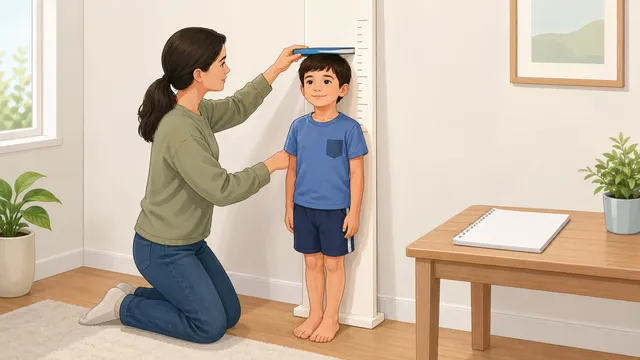
This page uses the mid-parental height formula, so the parent heights matter more than a child's current height, shoe size, or current growth spurt. Measure both parents as adults, without shoes, and keep the unit mode consistent.

The result is best read as a family target-height band. The midpoint is useful, but the lower and upper rows are often more practical when you compare the estimate with later growth-chart tracking or with family expectations.

Predicted height sheet

179 cm

Boy estimate from these parent heights is 179 cm, with the usual genetic target band running from 169 cm to 189 cm and a sex-specific midpoint shift of +6.5 cm.

The boy estimate sits 6.5 cm above the family midpoint because the mid-parental method applies the standard male offset.

169 cm

Low end

189 cm

High end

172.5 cm

Mid-parental midpoint

Boy estimate

Selected estimate

Family height snapshot

These rows keep the parents and midpoint in the currently selected unit so the estimate is easier to compare at a glance.

Compared with the taller parent, the selected estimate is 1 cm shorter. Compared with the shorter parent, it is 14 cm taller.

Father's height180 cm
Mother's height165 cm
Mid-parental midpoint172.5 cm
Selected estimate vs midpoint6.5 cm above
Parent height difference15 cm

Same parents, both target-height estimates

The formula shifts the midpoint by 6.5 cm in either direction, so this table shows both sex-specific target-height rows from the same parent heights.

EstimatePredicted heightLikely range
Boy estimate179 cm169 cm to 189 cm
Girl estimate166 cm156 cm to 176 cm

Target-height checkpoints

These rows turn the prediction into a lower-band, midpoint, and upper-band worksheet so the estimate is easier to compare with later growth records.

CheckpointHeightWhy it matters
Lower end of the usual band169 cmUseful as a screening floor when you compare the estimate with family pattern or later growth-chart tracking.
Target-height midpoint179 cmThis is the mid-parental estimate after the sex-specific adjustment, not a guaranteed final adult height.
Upper end of the usual band189 cmA child can still finish outside this band, but many healthy children will cluster somewhere inside it.

Measurement-sensitivity check

Because the formula averages both parents first, a small change in one parent shifts the estimate only part of the way. These rows show how much the result moves when the source heights were rounded or re-measured.

ScenarioPredicted heightShiftInterpretation
If both parent heights were 2 cm higher181 cm+2 cmBecause the method averages both parents first, a 2 cm change in both parents moves the estimate by the same 2 cm.
If only one parent height was 2 cm higher180 cm+1 cmA small correction to one parent affects the midpoint by half as much, which is useful when you are checking measurement quality.
If both parent heights were 2 cm lower177 cm−2 cmThis gives a quick sense of how much the estimate can move when the source heights were rounded up or taken in shoes.
Use this as a guide, not a promise The mid-parental height formula is a population estimate, not a promise. Puberty timing, nutrition, long-term health, sleep, and growth conditions can move final adult height above or below the predicted band. Use a paediatric growth assessment if there is a clinical concern.
← All Body Metrics calculators

Health — Body Metrics

Predicted Height Calculator

A predicted height calculator estimates a child's adult height from the heights of both parents. This page also explains the main assumptions behind the predicted height calculator result, highlights the supporting figures shown by the calculator, and helps the reader use the estimate without overstating what a quick online tool can prove.

How predicted height is calculated

The mid-parental height method calculates an average of both parents' heights, then applies a sex-specific correction: +6.5 cm for boys (to account for the sex height difference) and −6.5 cm for girls. This gives the predicted adult height for the child.

A ±10 cm range is applied around the predicted value, reflecting the Tanner-Whitehouse estimate that covers approximately 95% of outcomes for children of those parents. Actual adult height also depends on nutrition, childhood health, sleep quality, and other environmental factors during the growth period.

How to read the target height range

The headline number is the mid-parental target height, but the range around it is often more useful than the single figure. Most children do not end up exactly on the predicted number; they cluster somewhere within the expected band, which is why many height prediction pages show both a central estimate and a lower-to-upper bound.

That range is also what makes searches like target height calculator and predicted adult height calculator useful in practice. Families want to know whether a child is likely to fall within an expected genetic band, not just one exact number that may look more certain than it really is.

Showing the same parents with both the boy and girl formulas side by side also makes the midpoint easier to understand. The method starts from the same mid-parental average and then shifts it by 6.5 cm in either direction, which is why the sex-specific comparison table is useful.

Why the midpoint shifts by 6.5 cm

The mid-parental method starts with the average of both parents' adult heights and then applies a sex-specific offset of 6.5 cm. That is why the same parents produce two target rows that are 13 cm apart: one row sits 6.5 cm above the family midpoint and the other sits 6.5 cm below it.

Explaining the shift matters because many families assume the midpoint itself is the final answer. It is not. The midpoint is the family centre point, while the selected boy or girl estimate is the midpoint plus or minus the standard correction. Seeing both rows together makes the logic easier to audit and also helps users check that they entered the correct sex for the estimate they wanted.

Mid-parental midpoint = (father height + mother height) / 2

This is the family centre point before the boy or girl correction is applied.

Boy estimate = midpoint + 6.5 cm, Girl estimate = midpoint − 6.5 cm

The standard mid-parental adjustment moves the same family midpoint in opposite directions for the two sex-specific estimates.

Worked example: parents 180 cm and 165 cm

If one parent is 180 cm and the other is 165 cm, the mid-parental midpoint is 172.5 cm. For a boy, add 6.5 cm to get a target height of 179.0 cm. For a girl, subtract 6.5 cm to get a target height of 166.0 cm.

Applying the usual ±10 cm band gives a likely range of 169 to 189 cm for the boy estimate and 156 to 176 cm for the girl estimate. That range is what makes the formula useful for quick expectation setting, even though it cannot predict the final result precisely for one child.

Why predictions can miss the mark

Height prediction is strongest when you want a population-based estimate, but it is weaker when a child is growing unusually early or late, when parental heights are very far from average, or when health factors affect growth. Puberty timing, chronic illness, hormone issues, and undernutrition can all move final height away from the midpoint.

That is why a predicted height calculator should be treated as a guide rather than a diagnosis. It is especially useful for quick family estimates, growth discussions, and general planning, but it cannot replace a paediatric growth assessment or bone-age evaluation when there is a clinical concern.

Why measurement quality matters more than many parents expect

A small change in the parents' source heights changes the estimate immediately because the formula is built directly from those two numbers. If both parents are measured 2 cm taller than their true adult heights because shoes were left on or posture was overstated, the family midpoint also moves 2 cm higher and the selected estimate moves with it.

If only one parent's height changes, the effect is smaller because the method averages both parents first. A 2 cm change in one parent moves the midpoint by 1 cm. That is why the calculator now includes a measurement-sensitivity view: it helps families judge whether a surprising result is coming from growth interpretation or from the quality of the source measurements.

How to use this with a growth chart instead of against one

The mid-parental estimate and a child height percentile chart answer different questions. The predicted height formula asks what adult-height band fits the family pattern. A growth chart asks whether the child's current measurements are following a stable trajectory over time. The most useful interpretation usually combines both.

A child can sit on a low height percentile and still be growing appropriately if that path fits the family target pattern. A child can also have a respectable current percentile but still justify review if growth velocity is flattening, the child is crossing centiles downward, or puberty timing is clearly off the expected path. That is why a predicted height calculator is best used as context for growth follow-up rather than as a replacement for it.

Mid-parental height versus bone age and Khamis-Roche methods

The mid-parental method is attractive because it is simple, requires only the parents' adult heights, and gives a fast family-pattern estimate. However, it does not use the child's current age, current height, weight, or skeletal maturity. That is a major reason it stays in the category of screening guidance rather than a personalised growth forecast.

More detailed approaches such as bone-age interpretation or the Khamis-Roche method can add useful context when clinicians need a closer estimate, but those methods also require more data and still do not guarantee the final adult result. For most family-level questions such as how tall will my child be or what is my child's target height, the mid-parental method remains the practical starting point rather than the last word.

When a family target-height estimate should trigger follow-up

A target-height estimate is most useful when it supports a broader growth conversation. If a child's repeated height measurements are tracking well below the lower parental target range, or if the growth pattern is drifting away from family expectation over time, that can justify a clinician review. The formula itself does not diagnose short stature, delayed puberty, endocrine disease, or nutritional problems, but it can help show when the pattern is not obviously explained by family height alone.

That context becomes more important when other concerns are present, such as low weight gain, chronic gastrointestinal symptoms, fatigue, long-term steroid use, known chronic illness, or a marked mismatch between puberty timing and expected growth. In those situations, a paediatric assessment, growth-chart review, and sometimes bone-age testing matter much more than repeating an online estimate.

Frequently asked questions

How accurate is the mid-parental height formula?

The formula explains approximately 40–50% of variance in adult height — genetics is the strongest predictor but not the only one. For most children, the predicted value is within ±5 cm of actual adult height. The ±10 cm range covers the vast majority of outcomes, though outliers outside this range do occur.

Can I use current child height instead of parent heights?

Not with the mid-parental formula. This calculator is based on parental heights, not the child's current measurement. Other methods, such as bone-age prediction or growth-chart tracking, use the child's own measurements and can be more informative when a clinician is monitoring growth.

When should I ask a doctor about my child's height?

If a child is crossing centiles, growing much more slowly than expected, or seems very short or very tall compared with family pattern, a paediatrician should review the growth pattern. The calculator is best for broad estimation, not for ruling out growth problems.

Why does the result show a range instead of one exact adult height?

Because the mid-parental formula is a population estimate. Children with the same parent heights do not all finish at one number, so the ±10 cm band is often more useful than the midpoint alone when you are judging whether a growth pattern looks broadly in-family.

What is mid-parental height?

Mid-parental height is the average of both parents' heights, adjusted by a sex-specific offset to estimate a child's likely adult height. It is sometimes called target height, and it is a statistical estimate rather than a guarantee of the final result.

Can a bone-age scan predict adult height more accurately?

A bone-age assessment can add useful context when a clinician is reviewing a child's growth pattern, especially if puberty timing or a medical condition may be affecting height. It can improve interpretation, but it still does not turn the estimate into a certainty, and it is best used alongside a paediatric growth review.

Why does the same family show different target heights for a boy and a girl?

Because the formula starts with the same mid-parental midpoint and then applies a sex-specific offset. The boy row adds 6.5 cm and the girl row subtracts 6.5 cm, so the two target rows are 13 cm apart even though the parents' heights do not change.

How much does a small measuring error change the predicted height?

If both parents are measured 2 cm too high, the predicted target height also moves about 2 cm too high. If only one parent is off by 2 cm, the family midpoint changes by about 1 cm because the two heights are averaged first. That is why it is worth measuring adult heights carefully and without shoes before interpreting the result.

Does this calculator use the child's current age or current height?

No. This page is specifically a mid-parental height calculator, so it uses the parents' adult heights and the selected boy-or-girl formula only. It does not use current child age, current child height, weight, or bone age, which is one reason the result should be treated as a screening estimate instead of a personalised forecast.

What is the difference between predicted height and a height percentile?

Predicted height estimates the adult-height band that fits the family pattern. Height percentile shows where a child sits on a population growth chart at the current age. They are complementary tools: one gives family-based expectation and the other shows the current growth trajectory.

Can a child finish outside the usual ±10 cm band and still be healthy?

Yes. The band is useful because many children will finish somewhere inside it, but it is not a hard boundary between normal and abnormal. Puberty timing, nutrition, chronic illness, constitutional growth patterns, and wider genetic variation can all move final adult height above or below the usual band without automatically implying a disorder.

When is the mid-parental height formula less reliable?

It is less reliable when puberty timing is unusually early or late, when there are chronic medical or endocrine conditions, when the parental heights are measured poorly, or when the family pattern is unusual enough that a simple midpoint is not very representative. It is also weaker when the real question is clinical growth velocity rather than family expectation.

Should I use this result if my child already seems short for age?

You can use it as context, but not as reassurance by itself. If a child already seems short, is falling on formal growth charts, or is growing slowly, a paediatric review matters more than any single formula estimate. The best use of the calculator in that situation is to show the expected family band that the clinician can compare with the real growth pattern.


Also in Body Metrics

Related

More from nearby categories

These related calculators come from the same leaf category, nearby sibling categories, or the same top-level topic.