Estimate relative fat mass from height and waist circumference with sex-specific body-fat categories, example presets, waist-to-height context.
Last updated
RFM calculator for waist and height body-fat estimates Estimate relative fat mass from height and waist circumference, compare the result with BMI or a Navy-style body-fat screen, and see how the same formula behaves for men and women.
Formula snapshot
Men: RFM = 64 − 20 × (height ÷ waist). Women: RFM = 76 − 20 × (height ÷ waist).
Enter height and waist in the same unit. Add weight if you want a BMI comparison beside the RFM result.
Sex
Units
How to read the signal
RFM focuses on waist relative to height, so it often gives a better screen for central adiposity than BMI alone.
Use the half-height waist target and optional BMI comparison as practical checks, then compare with a Navy-style body fat calculator if you want a second method.
Enter your measurements Add a height and waist measurement, or load an example, to estimate relative fat mass and see the category band.
The Relative Fat Mass (RFM) calculator estimates body fat percentage from only two required measurements — height and waist circumference — without requiring any skinfold calipers or body composition equipment. Enter your sex, height, and waist to see your estimated body fat percentage, category band, waist-to-height context, half-height waist target, and optional BMI comparison when body weight is available.
The RFM formula
Men: RFM = 64 − 20 × (height ÷ waist). Women: RFM = 76 − 20 × (height ÷ waist). Both height and waist must be in the same unit (both cm or both inches). The formula was developed by Woolcott and Bergman (2018) and validated against DXA (dual-energy X-ray absorptiometry) body composition scans.
A larger waist-to-height ratio produces a higher RFM, reflecting that central adiposity (abdominal fat accumulation) is strongly associated with metabolic risk.
How RFM compares to BMI
In the Woolcott and Bergman validation study, RFM showed stronger correlation with DXA-measured body fat than BMI in both sexes. BMI does not distinguish fat from muscle and gives the same value for a lean muscular individual and an overweight but low-muscle individual with identical height and weight. RFM captures the waist dimension directly, making it more sensitive to central fat accumulation.
Measuring your waist correctly
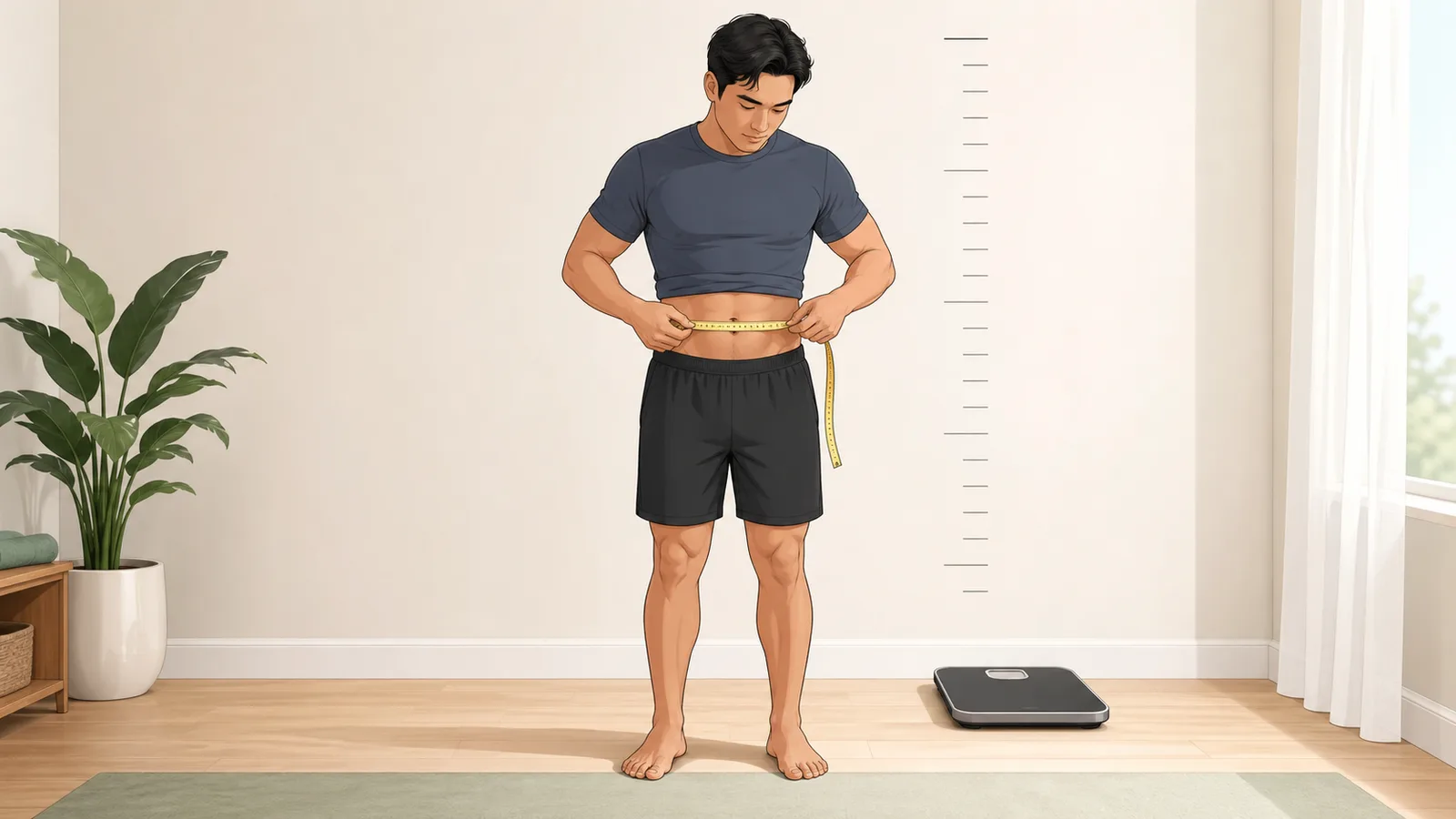
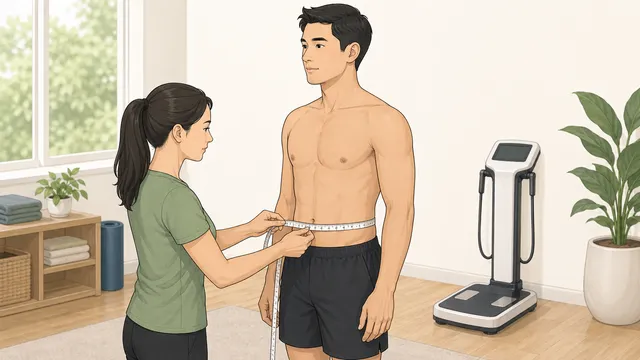
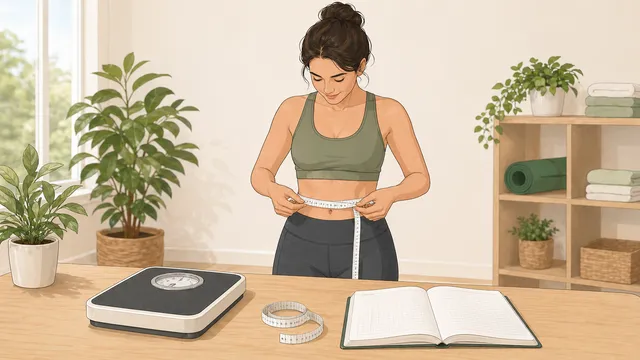
Measure your waist at the midpoint between the bottom of your lowest rib and the top of your hip bone (iliac crest) — typically at or near the navel. Stand relaxed, breathe out normally, and measure at the end of a normal exhale without holding your breath in. Consistency in measurement location matters for tracking changes over time.
Worked example: 178 cm height and 90 cm waist
For a man who is 178 cm tall with a 90 cm waist, the RFM formula gives 64 − 20 × (178 ÷ 90) = about 24.4%. In this calculator's reference bands that lands at the upper end of the average range rather than the fitness range.
That example shows what RFM is really doing: it turns waist relative to height into a body-fat estimate. If the same height is paired with a smaller waist, the estimated body-fat percentage drops; if the waist is larger, the estimate rises. The value is most useful when it is tracked consistently over time with the same measuring method.
How to measure height and waist for RFM
Height and waist must be measured in the same unit, either both centimetres or both inches. For the most consistent RFM result, stand upright, keep the tape level, and measure the waist after a normal exhale without pulling the tape tight enough to compress the skin.
The waist position matters just as much as the number itself. If you measure at a different point each time, the result will move even when body composition has not changed much. A simple calculator like this one is therefore best used with repeatable technique rather than one-off measurements.
Further reading
MedlinePlus — Obesity screening — NIH-backed guidance explaining why waist circumference matters and how body-size screening is used in context.
RFM is often easier to interpret than BMI because it uses waist circumference, which captures central adiposity instead of only comparing weight to height. That makes it useful when you want a body-fat estimate that responds to abdominal size rather than just overall weight.
Compared with the Navy-style body fat calculator, RFM is simpler because it needs only height and waist. The trade-off is that it gives you less detail than a more measurement-heavy method. If you want a second opinion, compare the result with BMI, waist-to-height ratio, or a Navy-style body fat calculator and look for a consistent pattern rather than one perfect number.
The calculator now shows how your waist compares with half your height because many waist-to-height screening guides use 0.5 as an easy practical reference point. This is not the same as the RFM formula, but it helps explain why the relative fat mass estimate rises when waist circumference increases faster than height.
If your waist is above half your height, the result table shows the difference in centimetres so you can track a concrete waist measurement target over time. If your waist is near or below half your height, the table still keeps the RFM estimate visible because the sex-specific formula and category bands remain the primary result.
Why the optional weight field is included
RFM does not need body weight, which is one of the reasons it is useful. The optional weight field is only there to calculate BMI beside the RFM result, so you can compare a waist-based body-fat estimate with the more familiar weight-to-height screening number.
The two values can disagree. A muscular person may have a higher BMI with a relatively lower RFM, while someone with less muscle and more central fat may see a waist-driven RFM result that is more concerning than BMI alone. Treat the comparison as context rather than a diagnosis.
Frequently asked questions
How accurate is RFM?
RFM correlates well with DXA body fat in population studies, but like any two-measurement formula it has estimation error. In the original study, RFM showed r² values around 0.70–0.80 for body fat prediction, which is better than BMI but still leaves significant individual variability.
Can I use RFM to track fat loss progress?
Yes — measuring your waist at the same location each time and recalculating RFM is a valid and practical way to track changes in central adiposity. Changes of 1–2 cm in waist measurement are detectable and meaningful.
Why does the female formula use 76 instead of 64?
Women naturally have a higher body fat percentage than men at the same waist-to-height ratio due to sex-specific fat distribution (more subcutaneous and reproductive fat). The higher constant in the female formula adjusts for this physiological difference.
Is RFM better than BMI?
RFM is often more informative than BMI for central fat distribution because it includes waist circumference. BMI still has value as a broad screening tool, but it cannot distinguish muscle from fat or show where fat is carried.
Can I use RFM without a body fat scale?
Yes. That is one of its main advantages. RFM only needs height and waist circumference, so it does not require calipers, scales, or a lab-based body-composition device.
What does a higher RFM result mean?
A higher RFM result means your waist is large relative to your height, which usually suggests more central body fat. That makes the result useful as a simple screening estimate, not as a diagnosis.
How should I track RFM over time?
Measure the same way each time, in the same unit, at the same waist position, and ideally under similar conditions. Consistency matters more than trying to chase an exact reading from one day to the next.
What if my measurements are in inches?
That is fine as long as both height and waist use the same unit. The calculator converts imperial inputs before applying the formula, so you can use either centimetres or inches.
Does RFM work for muscular people?
It is usually more forgiving than BMI for muscular people because it looks at waist size, but no single formula handles every body type perfectly. If you have very unusual proportions, compare the result with another body-fat method.
Why does the calculator ask for weight if RFM does not use it?
Weight is optional and is only used for the BMI comparison row. The RFM result itself still comes from sex, height, and waist circumference, so you can leave weight blank if you only want the relative fat mass estimate.
What does the half-height waist target mean?
The half-height target is a waist-to-height screening reference: a waist close to or below half your height is often easier to interpret than a body-fat percentage alone. It does not replace the RFM formula, but it gives a practical measurement target to track.